
Blog
USPAP 2024 Update Explained: What It Means for Lab Equipment Appraisals
The 2024 USPAP update changed how appraisers document inspections, workfiles, and ethics obligations. Here's what those changes mean for a defensible lab equipment appraisal report.
Every lab equipment appraisal we prepare, whether it's for an insurance claim, a merger, or a charitable donation, is built on a single professional standard: USPAP. The Uniform Standards of Professional Appraisal Practice govern how appraisers define an assignment, gather evidence, and report a conclusion, and the current edition took effect January 1, 2024. This guide walks through what USPAP actually requires, what changed in the 2024 edition, and why it matters when the subject is a centrifuge, a mass spectrometer, or an entire analytical lab.
What Is USPAP and Why Lab Equipment Appraisers Follow It
USPAP is the professional standard maintained by The Appraisal Foundation that governs appraisal work across personal property, real estate, business valuation, and mass appraisal. Laboratory equipment, analyzers, incubators, centrifuges, microscopes, and similar movable assets, is treated as personal property under USPAP when it isn't part of the real estate itself.
USPAP doesn't hand appraisers a formula or a fixed depreciation table. It's a framework: it tells the appraiser how to define the assignment, how to develop credible conclusions, and how to disclose the assumptions and limitations behind the number. That framework is why a lab equipment appraisal holds up under scrutiny from an insurer, a lender, an auditor, or a court, rather than reading like an informal guess.
Our appraisers hold credentials with organizations including the ASA, CAGA, and NEBB, all of which require adherence to USPAP alongside their own ethics codes. No single credential replaces USPAP; it sits underneath all of them as the baseline standard for the work.
Key takeaway: USPAP compliance isn't a marketing claim. It's the reason a lab equipment valuation can survive a challenge from an insurance adjuster, an opposing expert in litigation, or an IRS reviewer.
What Changed in the 2024 USPAP Edition
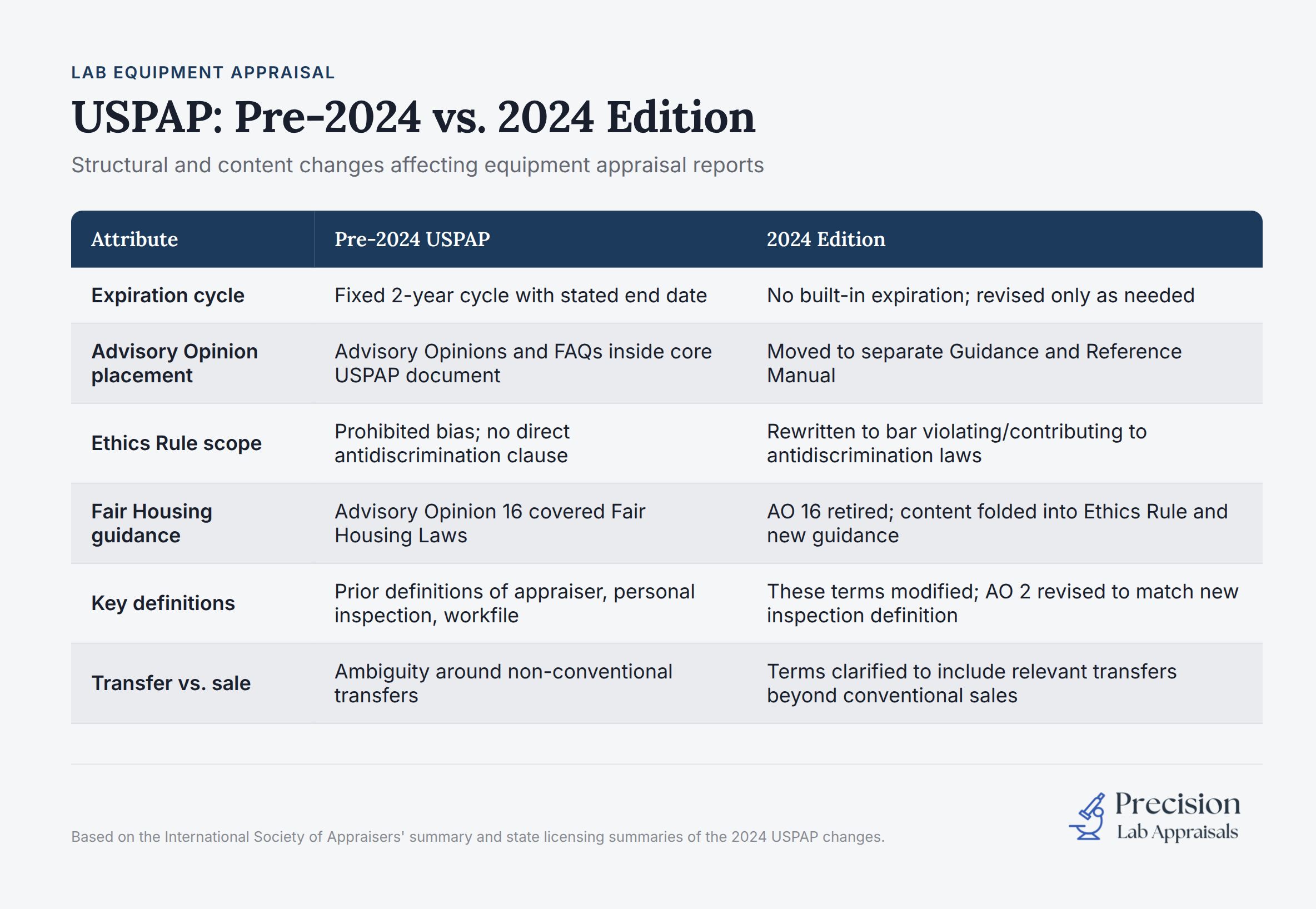
The 2024 edition took effect January 1, 2024, and its most structural change is one appraisers had never seen before: it has no built-in expiration date. Previous editions were published on a fixed two-year cycle with a stated end date. According to the International Society of Appraisers' summary of the update, the Appraisal Standards Board moved to a model where USPAP is revised only as needed, rather than automatically republished every two years.
Several other changes affect how an equipment appraisal report gets built:
- Advisory Opinions and FAQs split into a separate publication. Guidance that used to sit inside the core USPAP document now lives in a companion Guidance and Reference Manual, a structural reorganization rather than a change to the binding Standards themselves, as reflected in The Appraisal Foundation's current USPAP and Guidance and Reference Manual publications.
- The Ethics Rule was substantially rewritten. New nondiscrimination language now states directly that an appraiser must not act in a way that violates, or contributes to a violation of, federal, state, or local antidiscrimination laws. This sits alongside the long-standing prohibition on bias, defined as a preference or inclination that precludes impartial, independent, or objective analysis.
- Advisory Opinion 16 (Fair Housing Laws and Appraisal Report Content) was retired, with its substance folded into the Ethics Rule itself and newer advisory guidance.
- Key definitions were modified, including "appraiser," "personal inspection," and "workfile."
- Advisory Opinion 2 (Inspection of Personal Property) was revised to reflect the updated personal inspection definition.
- The terms "transfer" and "sale" were clarified, making clear that an appraiser's review of market activity should account for relevant transfers even when they don't take the form of a conventional sale.
A Standard That No Longer Expires on a Fixed Clock
Before 2024, appraisers could point to a printed edition with a stated effective period, most recently 2020-2021, and know exactly when the next revision would arrive. The 2024 edition changed that. It stays in force until the Appraisal Standards Board issues a new one, whenever that happens to be.
That doesn't reduce the burden on appraisers; if anything, it increases it. Appraisers can no longer assume a new edition is coming on a predictable two-year schedule. They have to actively monitor for interim updates, interpretations, and new advisory guidance rather than waiting for the next printed manual. Our appraisers track these updates as part of ongoing credentialing requirements, the same continuing education obligations that keep ASA, CAGA, and NEBB-affiliated appraisers current.
What the Ethics Rule Rewrite Means for Client Interactions
The expanded Ethics Rule has a direct, practical effect on how an appraisal report is worded and how an assignment is scoped. An appraiser can't accept an assignment, or phrase a conclusion, in a way that would violate applicable antidiscrimination law, and the bias prohibition means personal or client pressure can't shape a value conclusion toward a predetermined outcome.
For lab equipment specifically, this rarely comes up the way it does in residential real estate, where Advisory Opinion 16 originated. But the principle still governs how appraisers describe a facility, a seller, or a buyer in a report, and it reinforces that the appraiser's job is to reach an independent, defensible conclusion regardless of which party is paying for the report.
Watch out: A client who asks an appraiser to "help the number come in higher" for a loan application or lower for a tax filing is asking the appraiser to violate the bias prohibition. A USPAP-compliant appraiser will decline, every time.
Inspection and Workfile Documentation for Lab Instruments
The revised personal inspection definition matters more for lab equipment than almost any other asset category. Analyzers, spectrometers, and diagnostic equipment often can't be fully evaluated through a visual walk-through alone. A visual inspection confirms readily observable characteristics: manufacturer, model, serial number, apparent condition, and configuration. It does not, by itself, establish that an instrument is calibrated, contamination-free, or fit for regulated use.
The 2024 update ties the inspection definition more tightly to what an appraiser actually observed versus what they're assuming or relying on secondary evidence for. That means a rigorous lab equipment appraisal report should document the following:
- Identification detail: manufacturer, model, serial number, configuration, accessories, and software or firmware version where relevant.
- Condition and operating status as observed during inspection, distinguished clearly from claims about calibration or validation that were not independently tested.
- Calibration, maintenance, and service history, sourced from client records, service logs, or third-party documentation, with the source identified.
- Regulatory or quality-control status, where the equipment operates under FDA, CLIA, or similar oversight.
- Assumptions and limiting conditions stating plainly what the appraiser did and did not verify.
The workfile definition was also modified in the 2024 edition, reinforcing that appraisers must retain the research, data, and analysis behind every conclusion, not just the final report. For a lab equipment engagement, that workfile typically includes photographs, comparable sales or transfer data, cost inputs, and correspondence about the scope of the assignment. Our what is included in a lab equipment appraisal guide walks through the full documentation set in more detail.
Why USPAP Compliance Matters for Every Intended Use
A lab equipment appraisal gets used for a wide range of purposes, and each one depends on the report being built to a recognized standard rather than an informal estimate:
- Insurance claims and coverage rely on a documented, defensible value that an adjuster can't easily dismiss.
- Financing and collateral evaluations require lenders to trust the methodology behind the number, not just the conclusion.
- Tax and accounting purposes, including charitable donations, carry their own statutory requirements layered on top of USPAP. For a noncash donation of lab equipment, the IRS.gov qualified appraisal rules generally apply once the claimed deduction exceeds $5,000, and our IRS Form 8283 lab equipment donation appraisal guide covers that threshold and the required forms in detail.
- Litigation and dispute resolution put the appraiser's methodology and workfile under direct examination, sometimes years after the report was written.
- Equipment sales and dispositions, particularly where a facility is closing or consolidating, need a value that reflects real market evidence rather than a dealer's asking price.
USPAP itself doesn't set the $5,000 threshold, prescribe a depreciation schedule, or mandate functional testing on every instrument. Those come from the specific statute, contract, or intended use governing the assignment. What USPAP guarantees is that whichever value premise applies, fair market value, orderly liquidation value, or replacement cost new, the appraiser arrived at it through a transparent, repeatable process that another qualified appraiser could review and understand.
Keeping Lab Equipment Appraisals Current With the Standard
The 2024 USPAP edition didn't rewrite how lab equipment gets valued. It rewrote how appraisers document their work, disclose their ethics obligations, and define what counts as a proper inspection. For a lab, hospital system, or biotech company relying on an appraisal report, the practical upshot is a report that's more precise about what was observed, what was assumed, and what the appraiser is accountable for.
With no fixed expiration date on the current edition, appraisers can't treat USPAP compliance as a box checked once every two years. It's an ongoing obligation, one our team builds into every engagement from the initial scope call through final report delivery.
This article is provided for general informational purposes only and does not constitute legal, tax, or financial advice. Readers should consult a qualified attorney or CPA regarding their specific circumstances.