
Blog
What Is Included in a Lab Equipment Appraisal? A Scoping Guide for Owners
A lab equipment appraisal covers specific, itemized assets, not everything in the building. This guide breaks down which analytical instruments, support equipment, and durable apparatus are typically included, what gets excluded, and how to scope an engagement correctly.
What Does a Lab Equipment Appraisal Actually Cover?
A lab equipment appraisal values the specific instruments and durable apparatus identified for the engagement, not every item sitting on a bench or in a supply closet. The scope is built around an itemized inventory: each analyzer, balance, hood, or centrifuge gets identified, inspected where practical, and valued individually or in logical groupings.
Owners, CPAs, and attorneys who need to scope an engagement correctly should think in terms of asset classes rather than a single blanket category. Some equipment classes are almost always included. Others, like consumables or office furniture, sit outside the core definition of laboratory and test equipment unless the client specifically asks for them. Getting this distinction right before the engagement starts keeps the lab equipment appraisal focused, the fee predictable, and the resulting report defensible for whatever purpose it needs to serve, whether that is insurance, a sale, or a donation.
Analytical and Diagnostic Instruments Included in the Appraisal
The core of almost every lab equipment appraisal is the analytical and diagnostic instrumentation itself. These are the assets a lab cannot operate without, and they carry the bulk of the value in most engagements.
Common items in this category include:
- Microscopes, spectrographs, and other optical instruments used for analysis
- Chromatography systems, mass spectrometers, and elemental analyzers
- X-ray diffraction and X-ray fluorescence systems
- Blood, gas, oxygen, and pH analyzers
- Analytical, electronic, and mechanical balances
- Particle size analyzers and related metrology equipment
General industry classification practice groups these as primary laboratory instruments, distinct from the supporting equipment that keeps them running. That distinction matters for valuation because primary instruments often carry different useful-life expectations and depreciation curves than the equipment around them, a pattern reflected in normal useful life studies published by the American Society of Appraisers.
Support, Safety, and Processing Equipment Included in Scope
Support equipment is the second major bucket, and it is just as commonly included as the analytical instruments themselves. This is the equipment that makes the analytical work possible: containment, environmental control, and sample processing.
Typical items include:
- Fume hoods, biosafety cabinets, and laminar flow hoods
- Lab ovens, furnaces, incubators, and environmental or stability testing chambers
- Autoclaves and other sterilization systems
- Centrifuges and imaging systems used in clinical or research settings
- Bioreactors, fermenters, and cell or tissue culture equipment
- Durable, capitalized glassware, clean tables, and permanent apparatus that are tracked as fixed assets rather than expensed as supplies
A credentialed appraiser typically reconciles value under USPAP using the cost, market, and income approaches, with the cost approach (replacement cost new, less physical deterioration, functional obsolescence, and economic obsolescence) doing most of the work for specialized or thinly traded lab assets. That methodology is well established in equipment appraisal practice generally, not unique to laboratory settings, and it applies whether the assignment is scoped for insurance coverage or a merger review.
What a Lab Equipment Appraisal Typically Excludes
Not everything in the building belongs in a lab equipment appraisal. Several categories are routinely excluded unless the client specifically expands the scope to include them.
The most common exclusions are:
- Consumable supplies: Reagents, single-use labware, pipette tips, and other items that are used up rather than held as capital assets
- Low-value or disposable labware: Beakers, test tubes, and similar items typically expensed rather than tracked on a fixed-asset ledger
- Leasehold improvements and built-in real property fixtures: Plumbing, fume hood ductwork, and built-in casework attached to the building itself, which fall under real property rather than personal property
- Software and intangible assets: Laboratory information management system (LIMS) licenses and similar intangibles, which require a different valuation approach than tangible equipment
Excluding these categories isn't an oversight. It reflects how machinery and equipment appraisers have long classified assets: tangible, capitalized, individually identifiable items get appraised as personal property, while consumables, intangibles, and real property improvements are handled separately, if at all.
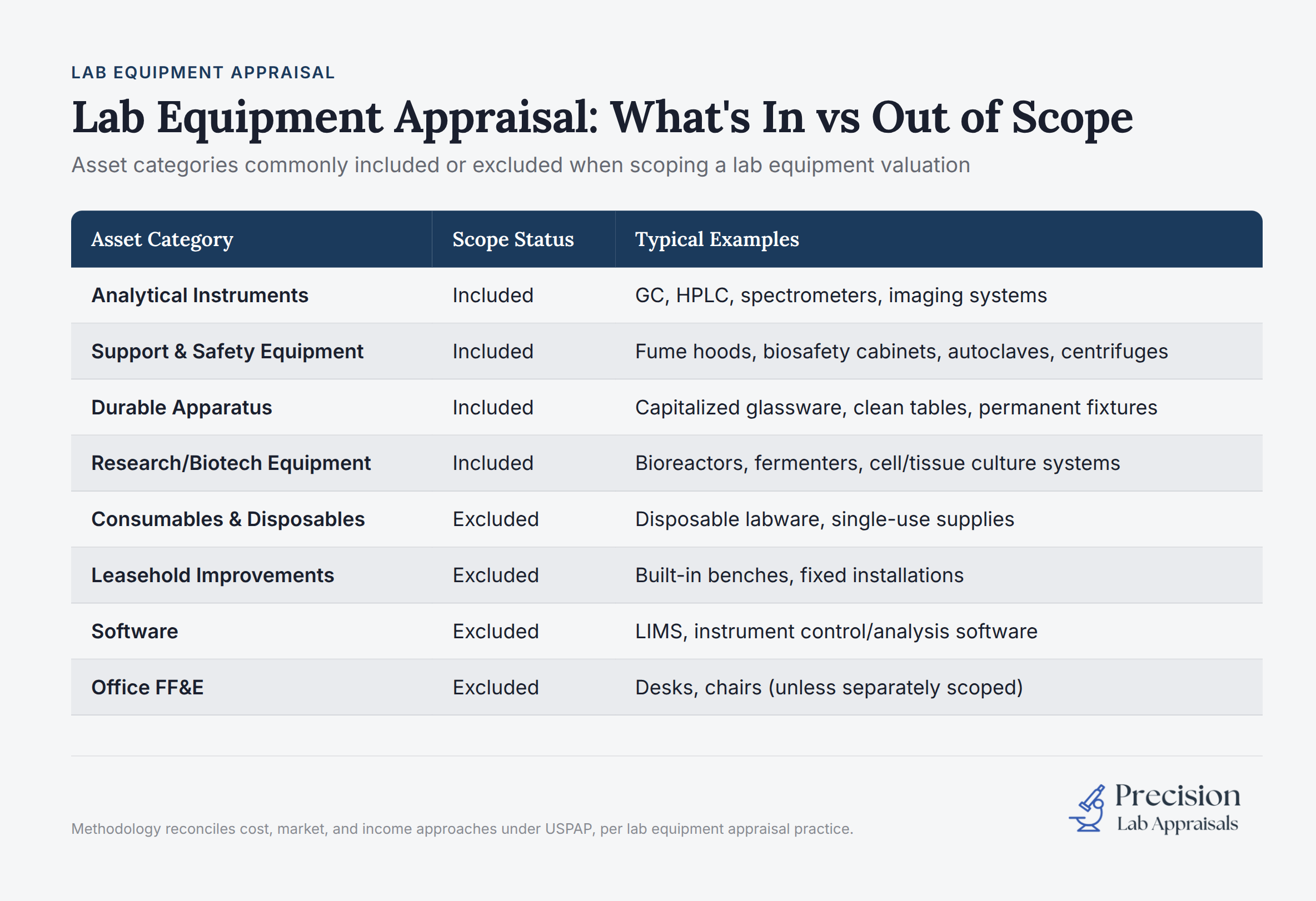
Included vs Excluded at a Glance
The table below summarizes how these categories typically break down in a standard scoping conversation.
| Category | Typically Included | Typically Excluded |
|---|---|---|
| Analytical instruments (microscopes, spectrometers, analyzers) | Yes | |
| Support equipment (fume hoods, incubators, autoclaves, centrifuges) | Yes | |
| Durable, capitalized glassware and apparatus | Yes | |
| Research/biotech equipment (bioreactors, cell culture systems) | Yes | |
| Consumable supplies and reagents | Yes | |
| Low-value, disposable labware | Yes | |
| Leasehold improvements and built-in fixtures | Yes | |
| Software and intangible assets | Yes | |
| General office furniture and fixtures | Only if separately scoped | Yes, by default |
Pro tip: Send your appraiser a walkthrough list or asset register before the engagement is quoted. It is far easier to add or remove categories at the scoping stage than to renegotiate scope mid-inspection.
Office Furniture and Fixtures: a Separate Asset Class
General office furniture, fixtures, and equipment (desks, chairs, filing cabinets, and similar items) can be included in a broader engagement, but it is a distinct asset class from laboratory and test equipment. If a lab wants its front-office furnishings valued alongside its instruments, that needs to be stated explicitly when the assignment is scoped.
This distinction comes up most often in two situations: a full facility appraisal ahead of a sale or merger, or a bankruptcy proceeding where every asset in the building needs to be accounted for. In either case, we recommend naming office FF&E as its own line item in the engagement letter rather than assuming it is bundled in with the lab equipment.
How Scope Drives the Appraisal Fee
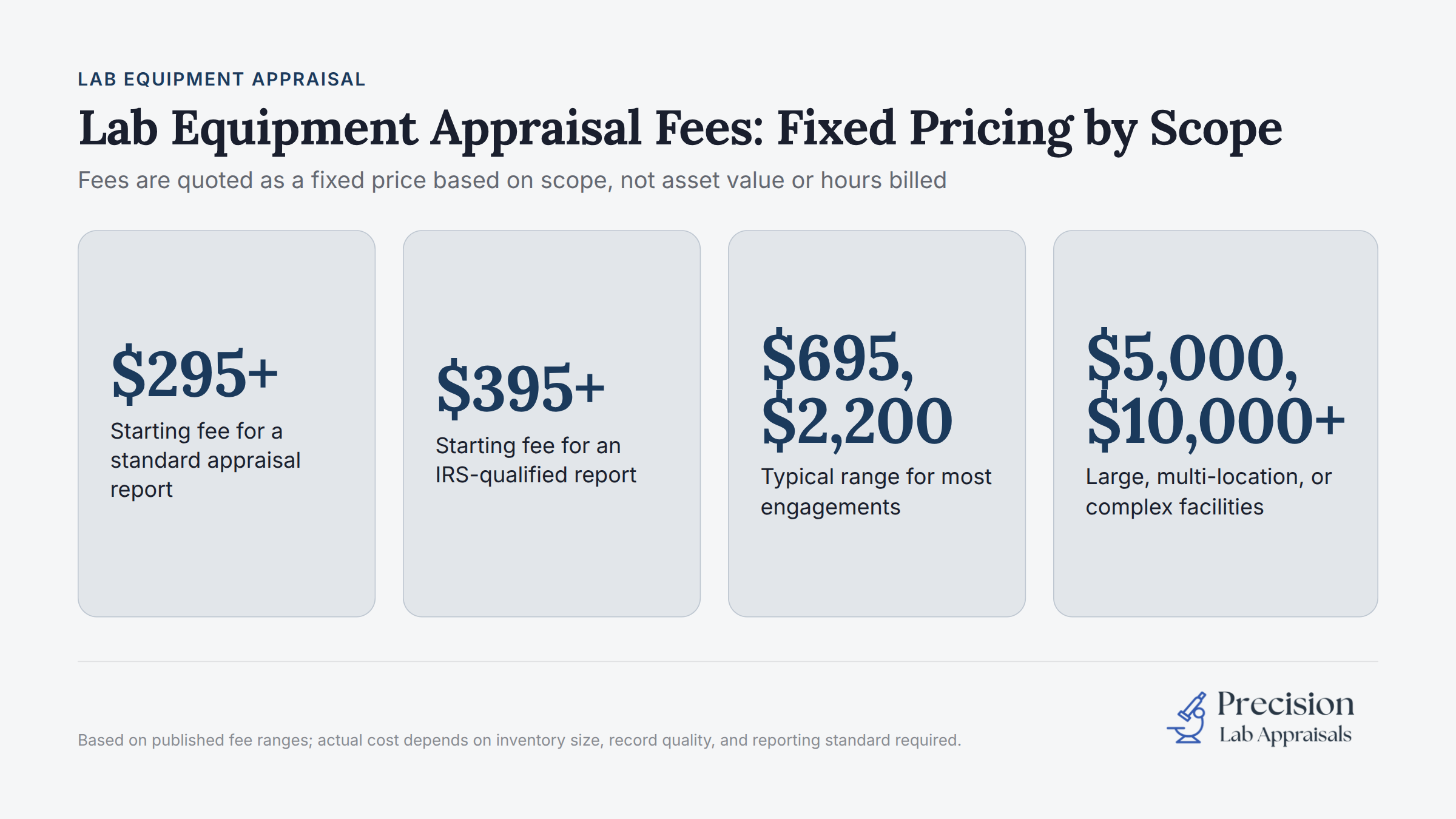
Fees for a lab equipment appraisal are quoted as a fixed price after the assignment is scoped, never billed hourly and never based on how much the equipment is worth. What actually drives the number is the scope of work: how many assets are on the list, how complete the existing records are, whether the report needs to meet IRS-qualified standards, and how much analysis each asset class requires.
Our published fee ranges for lab equipment appraisals start at $295 for a standard report and $395 for an IRS-qualified report, with most engagements landing between $695 and $2,200 depending on inventory size and complexity. Larger facilities with hundreds of instruments, multiple locations, or incomplete asset records can run $5,000 to $10,000 or more.
The practical takeaway: a lab with a clean, itemized asset list and 40 instruments will cost less to appraise than a facility with 400 assets scattered across several buildings and a decade of undocumented purchases, regardless of what either lab's equipment is ultimately worth.
Scope the Engagement Before You Call an Appraiser
The fastest way to keep a lab equipment appraisal on budget and on schedule is to decide the scope before the engagement starts. Pull together whatever asset list already exists, flag any office furniture or intangibles you want included, and note the intended use of the report (insurance, sale, donation, or litigation) so the appraiser can match the methodology to the purpose.
If you are not sure how to build that scope or which appraiser fits your facility, our guide on choosing a lab equipment appraiser walks through the credentials and questions to ask before you sign an engagement letter. When you are ready to move forward, our team can help you build an accurate asset list and provide a fixed-fee quote based on the scope you define.
This article is provided for general informational purposes only and does not constitute legal, tax, or financial advice. Readers should consult a qualified attorney or CPA regarding their specific circumstances.