
Blog
What Makes an Appraisal "Qualified" Under IRS Publication 561 for Lab Equipment?
A qualified appraisal under IRS Publication 561 has to meet specific appraiser-competency, content, and timing rules under Treasury Regulation 1.170A-17, not just a dollar figure on letterhead. This guide breaks down exactly what qualifies an appraiser and an appraisal for a donated analytical instrument, diagnostic system, or surplus lab.
A charitable deduction for donated lab equipment above $5,000 depends entirely on one word: qualified. The IRS does not accept just any appraisal, or any appraiser, for an analytical instrument, diagnostic system, microscope, or surplus laboratory lot. It requires a qualified appraisal prepared by a qualified appraiser, and both terms carry precise legal definitions under IRS Publication 561 and Treasury Regulation 1.170A-17.
This guide is written for the CPA, university or hospital asset manager, or lab director who already knows the $5,000 threshold exists. Our Form 8283 guide for lab equipment donations covers that mechanic and the filing process at a high level. Here, we go deeper into what actually separates a qualified appraisal from one the IRS can disregard: appraiser competency, prohibited appraisers, required document contents, and timing.
The Two-Prong Competency Test for a Qualified Appraiser
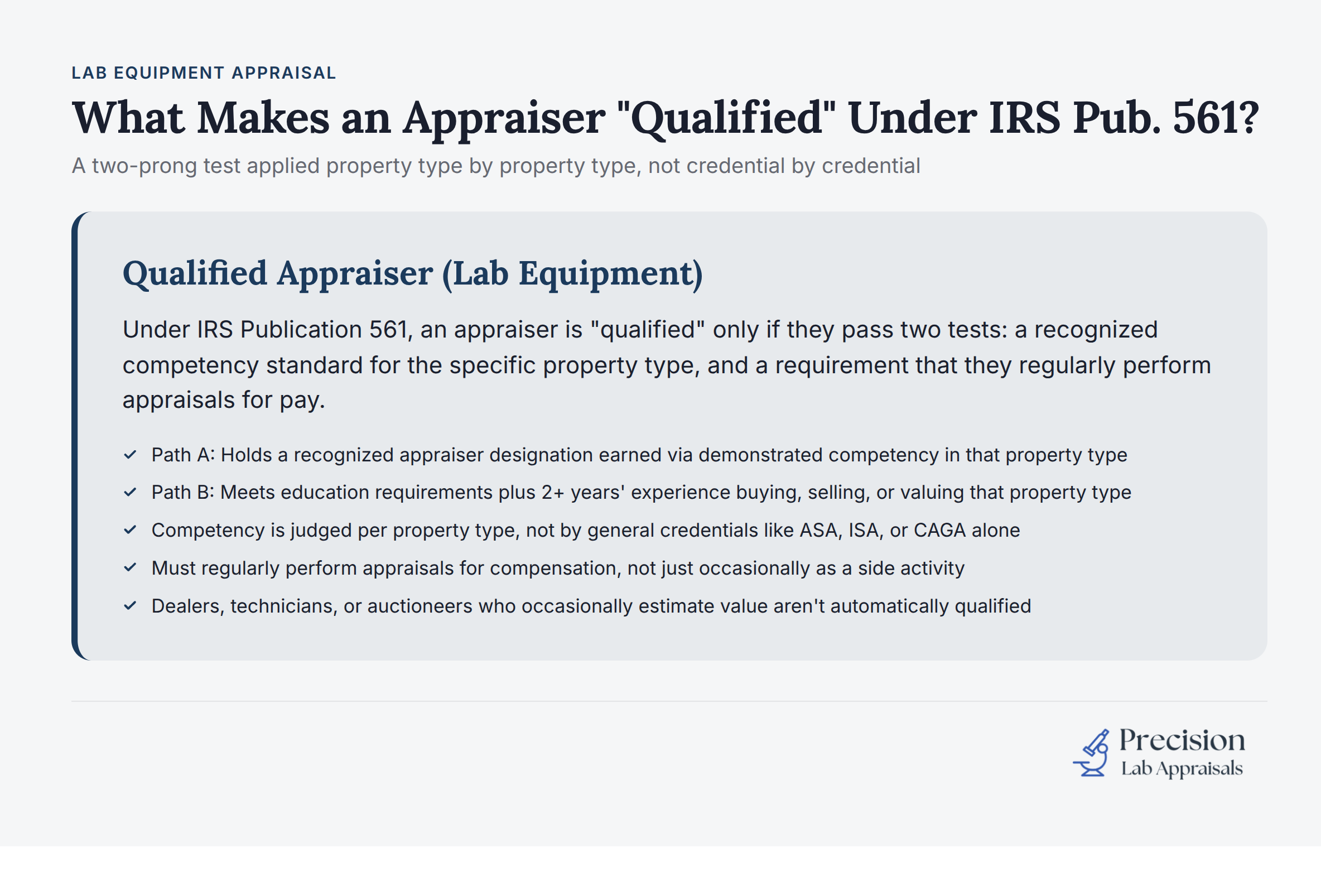
An individual is a qualified appraiser under federal tax law only if they clear two separate tests: a recognized competency threshold, and a requirement that they regularly perform appraisals for compensation.
The first prong has two paths. An appraiser either holds a recognized appraiser designation from a professional appraiser organization, earned through demonstrated competency in valuing the relevant type of property, or has met minimum education and experience requirements set by regulation: documented coursework in valuing that property type plus at least two years of experience buying, selling, or valuing it. The IRS's appraiser qualification rules apply this standard property type by property type, not credential by credential.
That distinction matters enormously for lab equipment. A credentialed personal property or machinery appraiser with no track record valuing analytical instruments, mass spectrometers, flow cytometers, or diagnostic imaging systems may not satisfy the competency requirement for that specific donation, even with a respected general designation. The strongest appraisals document the appraiser's actual experience in scientific and laboratory equipment markets, not just membership in an appraisal organization such as the ASA, ISA, or CAGA.
The second prong is simpler but just as absolute: the appraiser must regularly perform appraisals for pay, not occasionally value equipment as a side activity. A dealer, lab technician, or auctioneer who sometimes estimates equipment value is not automatically a qualified appraiser just because they handle the equipment professionally. Our lab equipment appraisal for charitable donation engagements are built specifically around this distinction: the appraiser assigned has demonstrable, documented experience in the equipment category being donated, not just general equipment credentials.
Who Is Legally Excluded From Being Your Qualified Appraiser
Several parties are barred from serving as the qualified appraiser on a donation, no matter how qualified they are in every other respect. The exclusion exists to prevent self-interested or related parties from inflating value.
The following persons cannot sign a qualified appraisal for a given donation:
- The donor making the contribution, or any party acting on the donor's behalf in the transaction.
- The donee organization receiving the equipment, including any employee of that organization.
- A party to the transaction in which the donor acquired the property, such as the equipment dealer who sold the donor the instrument, unless that party sold it to the donor within two months of the donation and the appraised value does not exceed the original acquisition price.
- Any employee, agent, or relative of the donor, the donee, or a party to the acquisition transaction, or anyone whose relationship to those involved would cause a reasonable person to question the appraiser's independence.
- An appraiser who regularly appraises for any of the above parties and does not perform a majority of their appraisals for other, unrelated clients during the tax year.
These exclusions are set out in Treasury Regulation 1.170A-17, and they apply even when the excluded person genuinely holds every other qualification. A hospital cannot use its own biomedical engineering director to appraise equipment the hospital is donating, and a university cannot rely on the equipment vendor who sold it the instrument three years earlier, even if that vendor is the most knowledgeable person available.
Watch out: a surplus-equipment liquidator who regularly buys the donor's old inventory is a common disqualifying relationship in lab and hospital equipment donations. If the same company both purchases your retired equipment and appraises your donated equipment, that overlap can void the appraisal's qualified status.
What a Qualified Appraisal Document Must Include
A qualified appraisal is a specific document with specific required contents, not just a signed value conclusion. The IRS's content requirements for qualified appraisals call for all of the following:
- A detailed description of the donated equipment and its physical condition, including manufacturer, model, serial number, configuration, accessories, and working or nonworking status.
- The date, or expected date, of the contribution.
- The terms of any agreement between the donor and donee relating to the use, sale, or other disposition of the property.
- Identifying information for the donor, including name, address, and taxpayer identification number.
- The appraiser's identifying information and a statement of the qualifications that make them competent to value this specific type of equipment, including relevant background, experience, and education.
- The date, or dates, on which the property was valued.
- The fair market value of the property on the valuation date.
- The valuation method used, such as comparable sales, replacement cost, or income approach, and the specific basis for the conclusion (comparable transactions, dealer listings, depreciation analysis, and similar support).
- The date the appraisal was prepared, which can differ from the effective date of value.
- A statement that the appraisal was prepared for income tax purposes.
Example: A research university donates a used mass spectrometer originally purchased for $120,000 six years earlier. A qualified appraisal cannot simply apply a standard depreciation percentage to the purchase price. It must identify comparable used-instrument sales or dealer listings, address the unit's calibration and service history, and explain why those comparables support the concluded fair market value as of the valuation date.
Pro tip: valuations built solely from a depreciation schedule, book value, or the donee's internal estimate almost never satisfy these content requirements on their own. Build the file around verifiable market evidence from the start.
The 60-Day Timing Window for Lab Equipment Appraisals
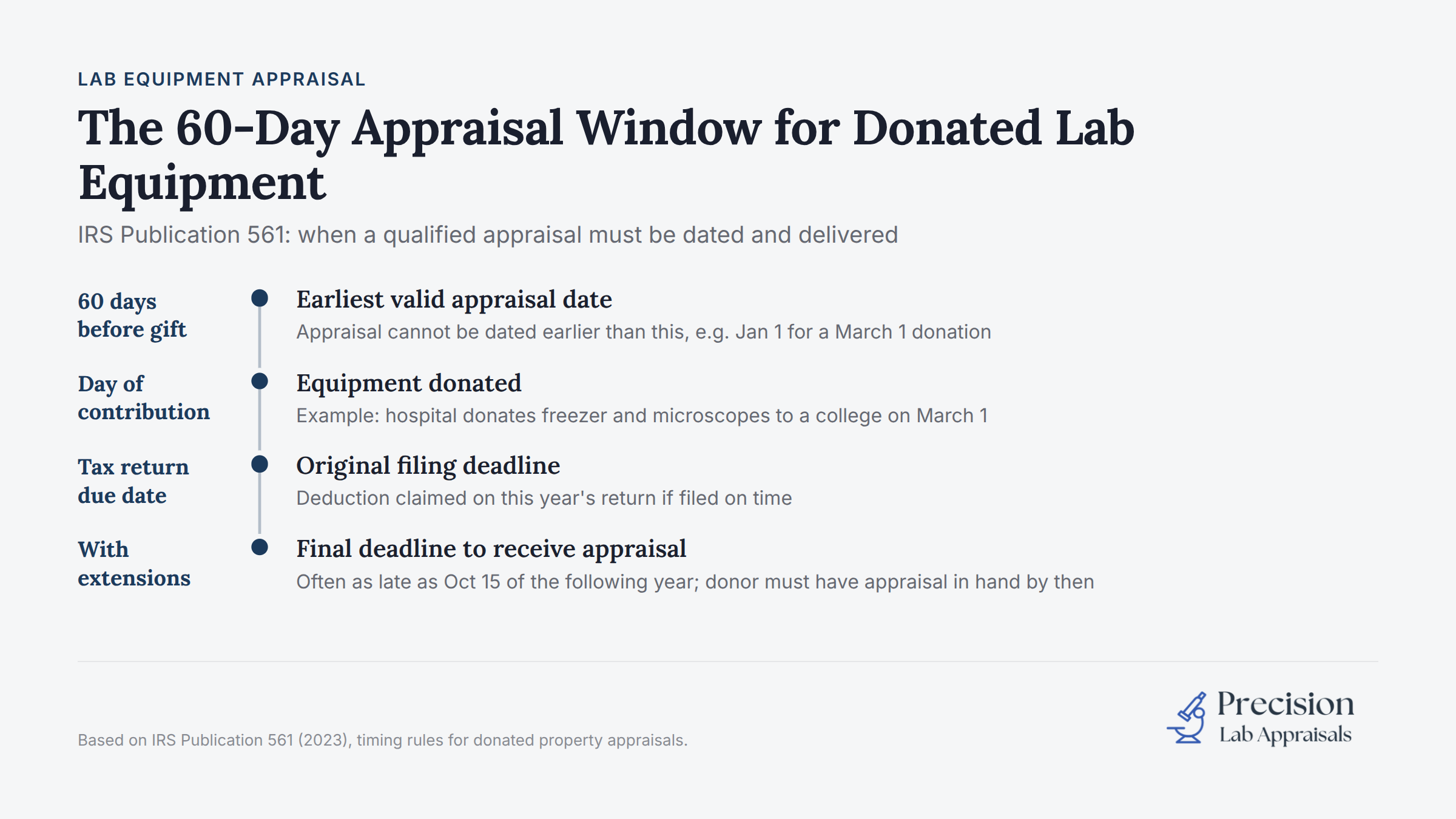
A qualified appraisal has to fall inside a specific timing window: it cannot be dated earlier than 60 days before the contribution, and the donor must receive the completed appraisal no later than the due date, including extensions, of the return on which the deduction is first claimed.
That window runs in both directions and trips up donors in predictable ways. An appraisal commissioned too far in advance of the gift (more than 60 days before the donation date) does not qualify, even if nothing about the equipment or the market has changed in the interim. On the other side, a donor who waits to request an appraisal until after filing their original return, without an extension, may have already lost the deduction for that tax year. These timing rules for donated property appraisals apply regardless of how straightforward the valuation itself turns out to be.
Example: A hospital system donates a retired -80°C freezer and three research microscopes to a community college biology program on March 1. The appraisal cannot be dated earlier than January 1 of that year (60 days prior). The hospital then has until the due date of its return, including any extension, often as late as October 15 of the following year, to have that appraisal in hand before claiming the deduction.
Why USPAP Compliance Matters for Lab Equipment Appraisals
Treasury Regulation 1.170A-17 requires that a qualified appraisal be conducted consistent with generally accepted appraisal standards, and Publication 561 points specifically to the substance and principles of the Uniform Standards of Professional Appraisal Practice (USPAP), published by The Appraisal Foundation. USPAP governs how an appraiser develops a value conclusion, documents the analysis, discloses assumptions, and reports findings, and it applies regardless of which credentialing organization an appraiser belongs to.
Compliance with USPAP does not require a specific credential by name. It requires an appraisal process that follows the recognized development and reporting standard, backed by an appraiser with verifiable, documented competence in valuing the specific equipment category at issue, whether that is laboratory analytical instruments, diagnostic systems, or surplus research equipment lots. Tax law also recognizes some reasonable-cause relief from valuation-misstatement penalties when the donor genuinely relied on a qualified appraisal from a qualified appraiser and made a good-faith investigation of value, but that relief does not substitute for meeting the underlying competency, content, and timing rules in the first place.
Build Your Qualified Appraisal File Before You Donate
The gap between "an appraisal" and "a qualified appraisal" is where most lab equipment donation deductions run into trouble: the wrong appraiser, a missing content element, or a document dated outside the required window can unravel an otherwise legitimate gift. Confirming appraiser competency, excluding any conflicted parties, and building the required documentation before the equipment leaves the building is far easier than trying to fix it after a return has already been filed.
If your organization is planning to donate analytical instruments, diagnostic equipment, microscopes, or an entire surplus lab, our team can request a lab equipment appraisal scoped specifically to meet these IRS requirements from the first document we produce.
This article is provided for general informational purposes only and does not constitute legal, tax, or financial advice. Readers should consult a qualified attorney or CPA regarding their specific circumstances.