
Blog
IRS Form 8283 Equipment Appraisal: How to Value Lab Equipment for a Charitable Donation
Donating a centrifuge, spectrometer, or full lab to a university or nonprofit triggers specific IRS Form 8283 equipment appraisal rules once the deduction passes $5,000. This guide walks through the qualified appraiser standard, the Section B signature requirements, and the documentation that keeps a donated-equipment deduction from being denied on audit.
What Triggers an IRS Form 8283 Equipment Appraisal?
Any noncash charitable donation over $500 requires IRS Form 8283, and once a single item of lab equipment or a group of similar items is valued above $5,000, the IRS requires a qualified appraisal and a completed Section B before the deduction is allowed. Institutions that receive equipment gifts, universities, teaching hospitals, and research nonprofits, need donors to get this right, because a rejected deduction often means a donor who is far less willing to give again.
Lab and scientific equipment donations are common: a retiring PI clearing out a centrifuge and spectrometer, a hospital upgrading imaging equipment and donating the older units, a biotech donating surplus bench equipment to a university program. Every one of these gifts runs through the same IRS mechanics. Our lab equipment appraisal for charitable donation service exists specifically to produce the documentation this process requires, but the rules below apply whether you use our team or another qualified appraiser.
The $5,000 and $500,000 Thresholds That Determine Your Filing Requirements
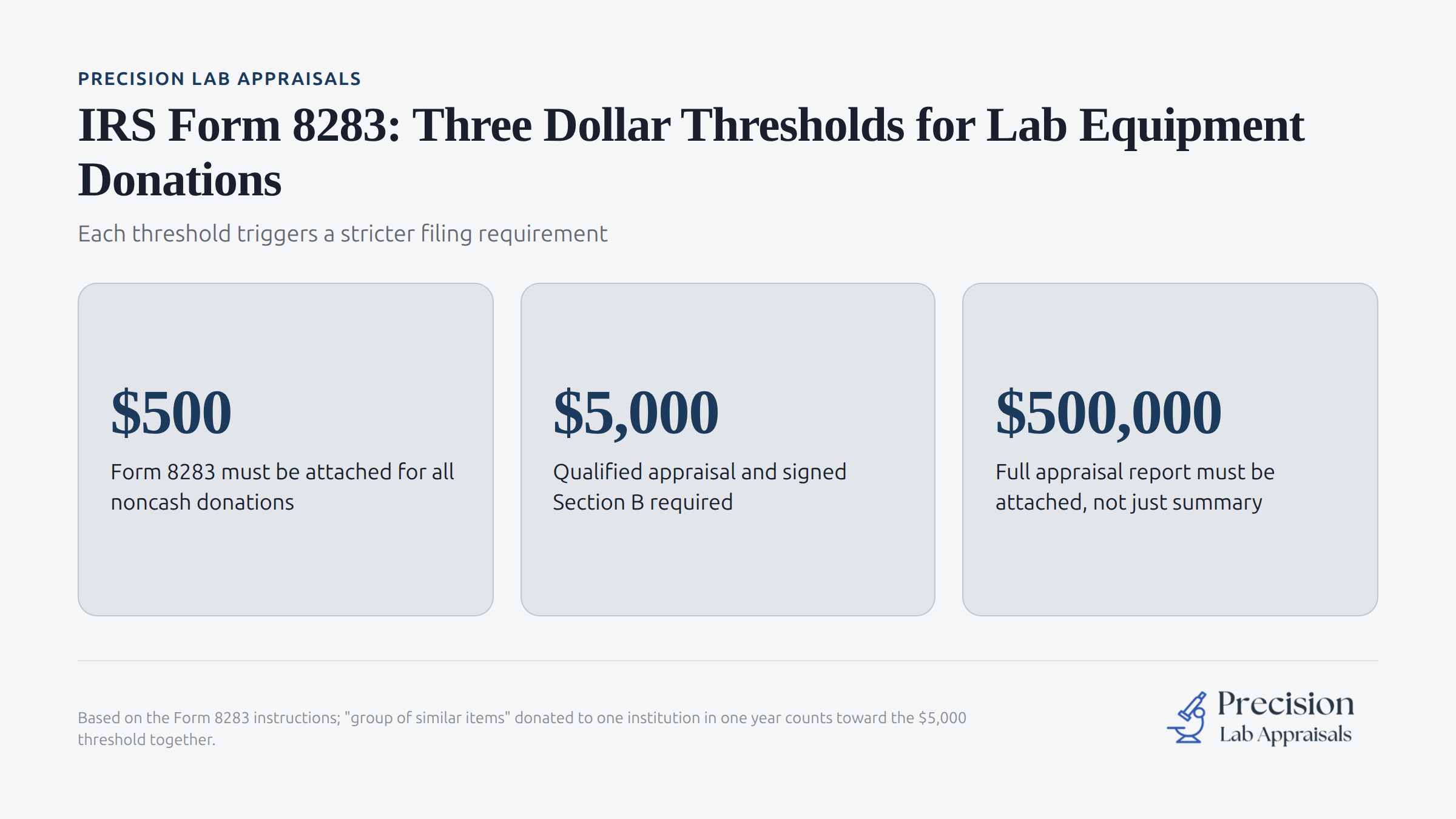
Three dollar thresholds govern how a lab equipment donation gets reported, and missing any one of them can jeopardize the deduction.
- Over $500 in total noncash donations for the year: Form 8283 must be attached to the return, covering all noncash property, not just the equipment.
- Over $5,000 for one item or a group of similar items: a qualified appraisal is required, and Section B of Form 8283 must be completed and signed by the appraiser, per the Form 8283 instructions.
- Over $500,000 for the donated property: the full qualified appraisal report itself must be attached to the return, not just the appraisal summary in Section B.
"Group of similar items" matters more than most donors expect. If you donate a centrifuge, a spectrometer, and a set of pipettes to the same institution in the same tax year, the IRS treats those as one group for threshold purposes, even though they are separate pieces of equipment with separate fair market values. A donor cannot avoid the $5,000 appraisal requirement by splitting one valuable donation across several Form 8283 line items.
Who Qualifies as a "Qualified Appraiser" Under Treasury Regulation 1.170A-17?
A qualified appraiser is someone with verifiable education and experience in valuing the specific type of property being appraised, who performs appraisals regularly, and who has no disqualifying relationship to the donor or the receiving institution. Treasury Regulation 1.170A-17 sets this standard, and it specifically excludes the property's seller, the donee organization, and anyone employed by either party in a way that would compromise independence.
For lab equipment, that means the appraiser should have direct experience valuing scientific, medical, or laboratory instruments, not just general personal property. An appraiser who regularly values antiques or vehicles but has never priced a mass spectrometer does not meet the substance of the standard, even if they hold a general credential. Our team's medical lab equipment appraisal work is built around appraisers who specialize in this exact category, which matters when a university's tax office or the IRS reviews the appraiser's stated qualifications on Form 8283.
Appraisers in this space typically hold credentials with organizations such as the American Society of Appraisers, the International Society of Appraisers, or CAGA, and every report should state it was prepared in accordance with USPAP (the Uniform Standards of Professional Appraisal Practice, set by The Appraisal Foundation). None of that substitutes for the specific 1.170A-17 qualifications the appraiser must state in the report itself.
Completing Form 8283 Section B: Parts I Through IV
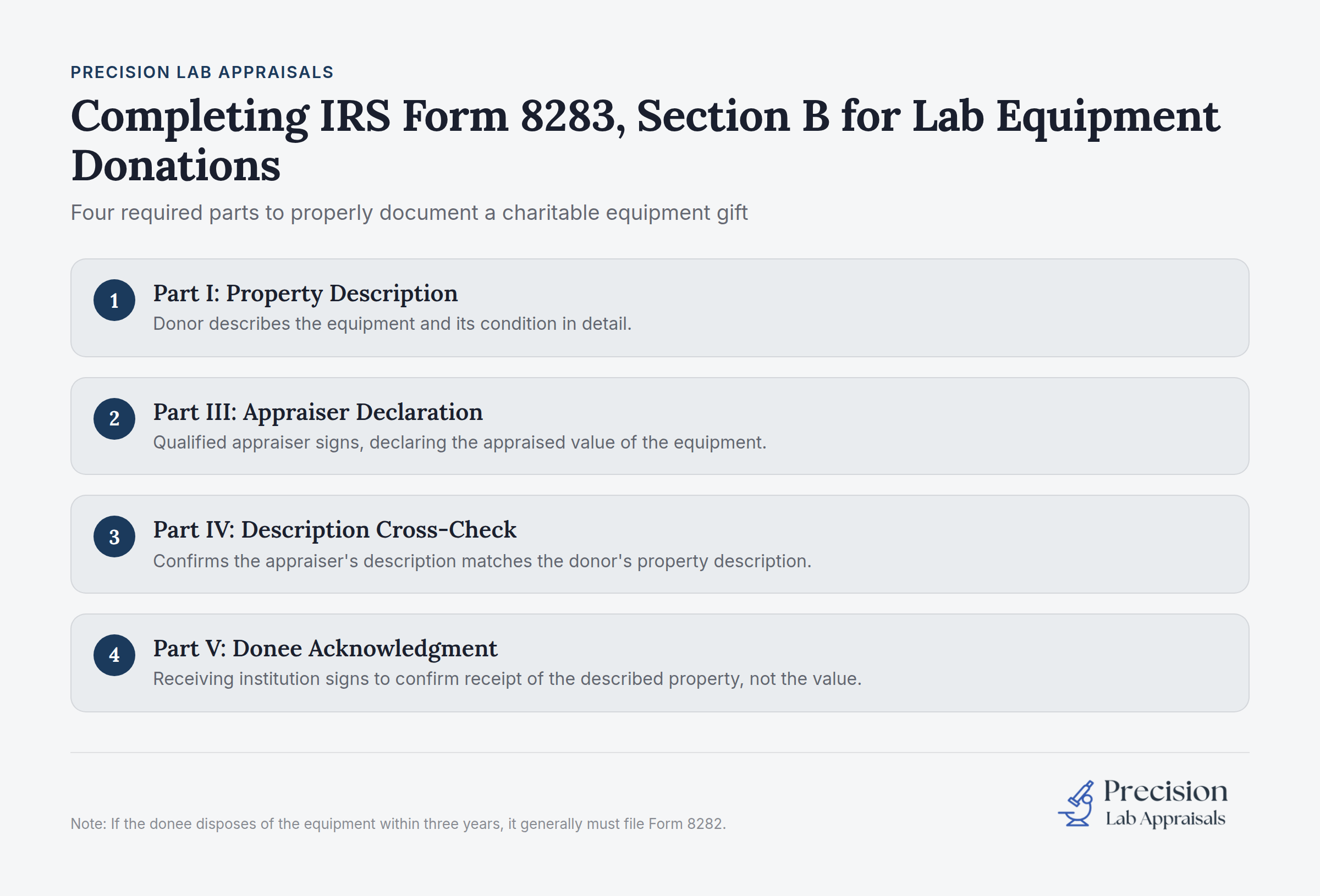
Section B of Form 8283 has four parts that build the record the IRS reviews if the deduction is questioned. Part I identifies the donated property: description, physical condition, how and when the donor acquired it, the donor's cost basis, and the appraised fair market value. Part II covers partial interests, which rarely applies to a straightforward equipment gift. Part III is the declaration of the appraiser, where the appraiser attests to their qualifications and signs under penalty of perjury that the appraisal meets the qualified appraisal standard. Part IV, sometimes labeled with the donee acknowledgment depending on the form revision, confirms the property description matches what the organization actually received.
For lab equipment specifically, Part I needs more than "used lab equipment, $8,000." The description should include the manufacturer, model number, and serial number, along with a plain description of physical condition (fully operational, needs calibration, cosmetic wear only, and so on). A vague description is one of the fastest ways to invite an audit inquiry, because it gives the examiner nothing to verify against the appraisal.
The Donee Acknowledgment in Part V
The donee organization, the university, hospital, or research nonprofit receiving the equipment, must sign Form 8283 acknowledging receipt of the specific property described. This signature does not endorse the appraised value; it only confirms the organization received the item described. Many institutions have a gift-in-kind or advancement office that handles this signature as a matter of course, but donors should confirm the signature is obtained before filing, since a Form 8283 missing the donee signature is incomplete.
Watch out: if the receiving institution sells, exchanges, or disposes of the donated equipment within three years, it generally must file Form 8282 to report that disposition. This does not fall on the donor, but donors giving equipment to a university lab or hospital department should be aware that the paper trail does not end at the acknowledgment signature.
How to Document Fair Market Value for Lab Equipment
Fair market value for donated lab equipment is the price a willing buyer would pay a willing seller in the used-equipment market, not the original purchase price and not full replacement cost. IRS Publication 561 describes the acceptable methods for reaching that figure, and for equipment the two that matter most are comparable sales and replacement cost adjusted for depreciation.
A defensible appraisal for a centrifuge, spectrometer, or similar instrument typically documents:
- Manufacturer, model, and serial number, so the specific unit can be verified against the donation record.
- Physical condition, including whether the unit is fully calibrated and operational or requires service.
- Comparable sales data, drawn from used scientific-equipment dealers, auction results, or broker listings for the same or a closely comparable model.
- Replacement cost as a cross-check, adjusted downward for age, wear, and any technological obsolescence, since Publication 561 treats replacement cost as a starting point rather than the final answer.
- The valuation date, which must match the date of the gift, not the date the appraiser happened to inspect the equipment.
"Similar items of property means property of the same generic category or type, such as stamp collections, coin collections, lithographs, paintings, photographs, books..." This same logic (the IRS's generic-category grouping standard) is what determines whether several pieces of lab equipment donated together count as one group for the $5,000 threshold.
Timing: When the Appraisal Must Be Completed
The appraisal cannot be dated more than 60 days before the date of the gift, and the donor must receive the completed appraisal and Form 8283 no later than the due date, including extensions, of the tax return claiming the deduction. Filing the return without the appraisal in hand, intending to attach it later, does not satisfy the requirement.
This timing rule catches donors more often than any other part of the process. A lab clearing out equipment in December, for example, needs the appraisal either dated within the 60 days before the gift or completed shortly after, well before the following April's filing deadline (or the extended deadline if the donor files for one). Waiting until tax season to start the appraisal process on a large equipment gift is a common and avoidable mistake.
The Grouping Rule for Similar Items, Applied to a Lab Donation
When a donor gives multiple pieces of equipment to the same institution in the same year, the IRS aggregates similar items to determine whether the $5,000 and $500,000 thresholds are crossed. A single donated pipette worth $300 would never need an appraisal on its own. But if that pipette is donated alongside a centrifuge and a balance in the same year, and the group's combined value exceeds $5,000, the group as a whole needs a qualified appraisal, even though no single item crosses the threshold by itself.
Pro tip: when donating a full lab clearout, it is almost always more efficient to have one qualified appraisal cover the entire group of equipment rather than piecing together separate valuations, since the IRS is going to evaluate the group's aggregate value anyway.
Worked Example: Donating a Used Centrifuge and Spectrometer
A university research lab is closing and donates two items to a nonprofit research institute: a refrigerated centrifuge originally purchased for $22,000 and now eight years old, and a UV-Vis spectrometer purchased for $15,000 and now five years old.
| Item | Original Cost | Age/Condition | Appraised FMV |
|---|---|---|---|
| Refrigerated centrifuge | $22,000 | 8 years, functional, minor cosmetic wear | $3,200 |
| UV-Vis spectrometer | $15,000 | 5 years, fully calibrated | $4,100 |
| Combined group | $37,000 | $7,300 |
Neither item alone crosses $5,000, but because both are donated to the same institution in the same tax year and fall into the same generic equipment category, the IRS treats them as a group. The combined appraised value of $7,300 exceeds the $5,000 threshold, so the donor needs a qualified appraisal covering both units, Section B of Form 8283 completed and signed by the appraiser, and the donee institution's signature acknowledging receipt. Because the total stays well under $500,000, the donor does not need to attach the full appraisal report, only the completed Form 8283, though keeping the appraisal on file for IRS records is still required.
Getting the Documentation Right the First Time
A lab equipment donation can support a legitimate deduction, but only when the valuation, the appraiser's qualifications, and the paperwork all meet the specific standards the IRS has written into Form 8283 and its supporting regulations. The most common failure points are a vague equipment description, an appraisal dated outside the 60-day window, and a missing donee signature, all of which are easy to avoid with a bit of planning before the gift is made.
Our appraisers prepare lab equipment appraisals for charitable donation built around these exact IRS requirements, with fixed fees quoted after we scope the assignment. If you're weighing which appraiser to use for a university or hospital equipment gift, our guide on how to choose a lab equipment appraiser covers what to check before you commit.
This article is provided for general informational purposes only and does not constitute legal, tax, or financial advice. Readers should consult a qualified attorney or CPA regarding their specific circumstances.