
Blog
How to Choose a Lab Equipment Appraiser
Not every machinery appraiser has the specialized knowledge to value analytical instruments, biotech equipment, or clinical lab assets. This guide covers the credentials to verify, the questions to ask, and the red flags that should end the conversation before you hire.
Lab equipment appraisal is a specialized discipline. The wrong appraiser, one without documented credentials, USPAP training, or genuine experience with scientific instrumentation, produces a report that a lender, insurer, or court can legitimately challenge. This guide covers what credentials to verify, which questions separate qualified appraisers from generalists, and which warning signs should stop the conversation cold.
Key Credentials to Look For in a Lab Equipment Appraiser
Credentials are not decorative. They represent documented training, peer review, and ongoing accountability to an external professional body. For lab equipment, two designations are particularly relevant, and one universal standard applies to both.
AMEA Certified Equipment Appraiser (CEA)
The Certified Equipment Appraiser designation is issued by the Association of Machinery and Equipment Appraisers (AMEA) and represents one of the most rigorous pathways in the equipment appraisal field. To earn the CEA, a candidate must demonstrate a minimum of 5 consecutive years of active machinery and equipment market experience, complete and pass the 15-hour USPAP course and exam, and submit a peer-reviewed appraisal report that meets AMEA standards. Maintenance requires 70 hours of continuing education every 5 years and an AMEA Review Committee appraisal review every 4 years.
The CEA is the senior-level AMEA designation. It signals that the holder has not just studied valuation theory but has practiced it long enough to be accountable to a peer review process. For a complex lab inventory, that accountability matters.
ASA Machinery and Technical Specialties Designation
The American Society of Appraisers offers accreditation specifically in Machinery and Technical Specialties, a discipline that directly covers laboratory instrumentation. As the ASA's own guidance on choosing an equipment appraiser explains, ASA-accredited appraisers have completed formal training, passed written examinations, submitted demonstration appraisal reports for peer review, and agreed to comply with a professional code of ethics.
The ASA uses three grades of membership: Accredited Member (AM), Accredited Senior Appraiser (ASA), and Fellow (FASA). Each grade reflects a progressively higher threshold of experience and demonstrated competency. All ASA members are required to comply with USPAP for every appraisal assignment, which makes the designation externally verifiable in a meaningful way. You can confirm current membership status directly with the ASA rather than taking a candidate's word for it.
USPAP Compliance: The Baseline Standard
Regardless of which professional designation an appraiser holds, compliance with the Uniform Standards of Professional Appraisal Practice is the floor, not a differentiator. USPAP is published and maintained by The Appraisal Foundation and applies to all written appraisal reports and oral appraisal communications.
To achieve USPAP competency, an appraiser must complete the 15-hour USPAP qualification course and examination. USPAP updates on a periodic cycle, and appraisers are expected to stay current. As industry guidance confirms, the IRS has made clear that a "qualified appraisal" for federal tax purposes means an appraisal performed in compliance with USPAP. That same standard applies to reports used for insurance, financing, litigation, and financial reporting.
When evaluating any appraiser, ask not just whether they claim USPAP compliance but whether they can show evidence of recent USPAP coursework. The claim is easy to make. The documentation is easy to verify.
Questions to Ask Before Hiring a Lab Equipment Appraiser
A structured set of questions asked before engagement will surface the difference between a credentialed specialist and someone who handles general personal property. Work through the following before signing anything:
What credentials do you hold, and are they current? Acceptable answers name a specific issuing organization (AMEA, ASA, NEBB) and confirm active standing. An answer like "I have years of experience" without naming a credential body is not sufficient.
Have you appraised lab equipment similar to mine? Analytical chemistry instruments, biotech hardware, controlled-temperature storage, and clinical analyzers are not interchangeable asset categories. Ask specifically whether the appraiser has handled comparable equipment, and ask them to describe one such assignment.
Can you provide a sample report or describe your methodology? A qualified appraiser should be willing to walk you through the structure of a completed report (redacted as necessary for confidentiality). If they cannot describe their methodology in plain language, that is a problem.
What valuation approaches do you use? The three recognized approaches are cost, sales comparison, and income. A capable appraiser can explain which of these applies to your equipment type and intended use, and why.
Will the appraisal comply with USPAP? This should be a yes, stated plainly and backed by documentation of current USPAP training if you ask for it.
What intended uses are you experienced with? Insurance, equipment financing, business dissolution, purchase price allocation, charitable donation, and estate tax each carry different reporting requirements. Confirm the appraiser has done assignments with the same intended use as yours.
Do you carry errors and omissions (E&O) insurance? Professional liability coverage is a basic indicator of a serious practice. Many institutional clients and lenders require it. If the appraiser does not carry it, you absorb the risk of an incorrect valuation.
Will you provide a written fee agreement and scope of work before starting? A professional engagement begins with a written document that defines the scope, deliverables, timeline, value premise, and fee. Industry guidance consistently identifies this as a non-negotiable step in a legitimate appraisal engagement.
Can you provide references from similar assignments? Appraisers have a confidentiality obligation to clients, but with client permission they should be able to supply references from comparable lab or research engagements. If none are available, that tells you something about their specialty depth.
Red Flags When Selecting a Lab Equipment Appraiser
Not every warning sign announces itself. Some are subtle. Here is what to watch for.
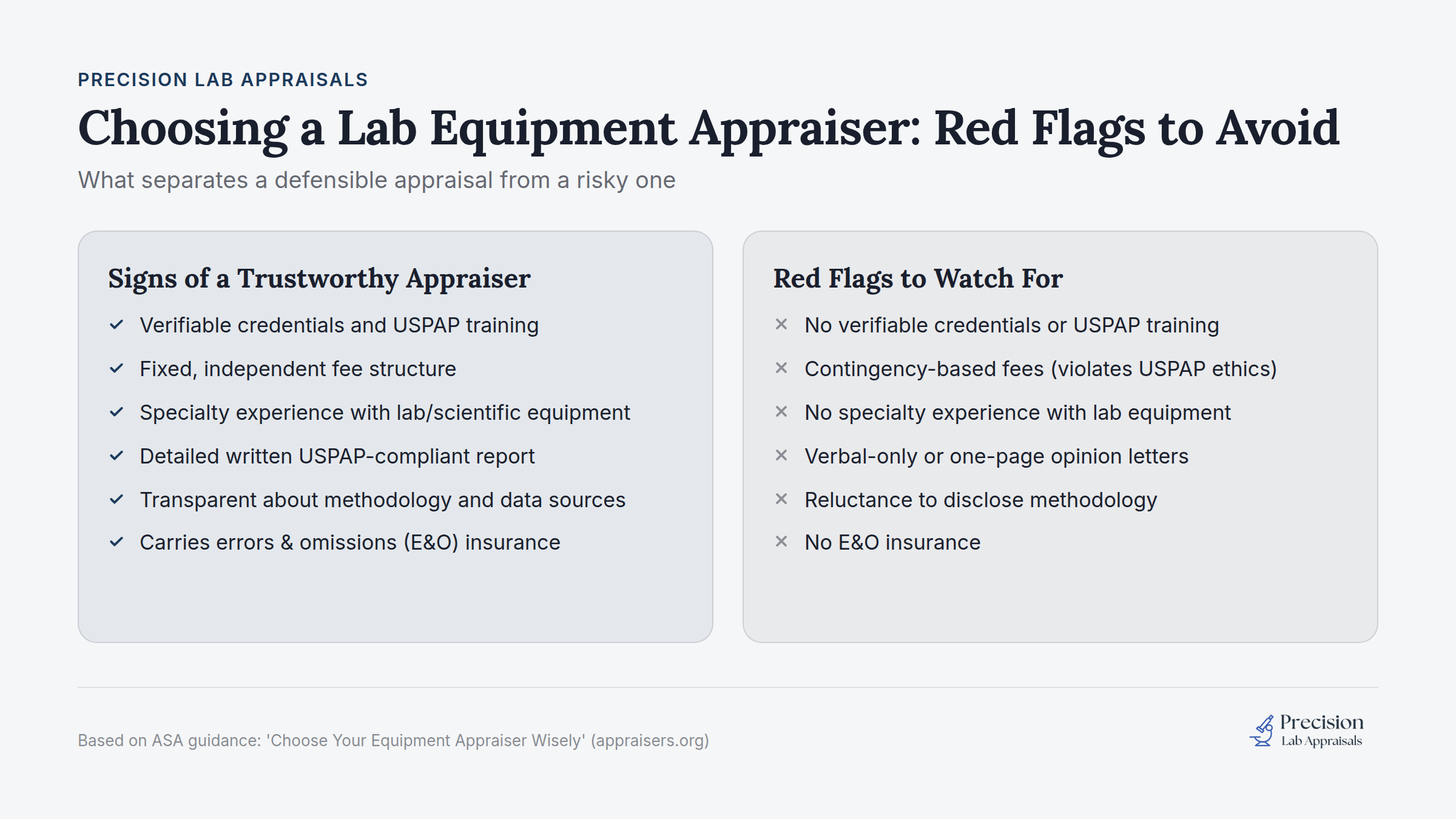
No verifiable credentials. An appraiser who cannot name a credential-issuing organization or produce evidence of USPAP training should not be trusted with a complex lab inventory. The absence of credentials is not a question of style; it is a factual gap that affects the defensibility of the report. If a lender, insurer, or opposing counsel asks how the appraiser was qualified, "years of experience" is not a satisfactory answer.
Contingency-based fees. This is a hard stop. Any appraiser whose fee is tied to the value they produce is violating USPAP ethics, full stop. USPAP explicitly prohibits contingent fee arrangements because they compromise independence. Walk away immediately if this comes up. The ASA's guidance on choosing equipment appraisers identifies this as a disqualifying practice.
No specialty experience with lab or scientific equipment. A generalist personal property appraiser who typically handles residential contents or antiques may be thoroughly credentialed and still lack the domain knowledge to accurately value analytical instruments, pharma-grade freeze-dryers, or HPLC systems. The IRS and professional standards bodies both recognize that experience in the specific type of property being valued is a qualification factor in its own right. A credential without the relevant specialty experience is incomplete for your assignment.
Verbal-only or one-page letters of opinion. A USPAP-compliant appraisal report for a significant asset or portfolio is a detailed written document. It includes identification of the property, the effective date of value, the value premise, the methodology applied, comparable market data, assumptions and limiting conditions, a certification, and the appraiser's signature. A one-page letter stating an opinion of value is not a defensible appraisal. It will not satisfy a lender, an insurer processing a major claim, or a court.
Reluctance to disclose methodology. A qualified appraiser can explain, in plain language, which valuation approaches they used for your asset type and why those approaches are appropriate for your intended use. They can describe how they sourced market data, how they accounted for depreciation and obsolescence, and what assumptions they made. If an appraiser becomes evasive when you ask these questions, treat it as a serious warning. The methodology is not proprietary; it is part of what you are paying for.
No E&O insurance. If the appraiser's value is challenged in court, disputed by a lender, or questioned by an insurer, and the appraiser carries no errors and omissions insurance, the exposure falls to you. Professional liability coverage is a basic indicator of a practice that takes its work seriously enough to be accountable for it.
FAQ
Q: Does a lab equipment appraiser need to be on-site?
Not always. For many standard assignments, a qualified appraiser can work from a detailed inventory list, equipment photographs, and relevant documentation without visiting the facility. Online and desktop appraisals are common for single-location labs with organized asset records. On-site inspection is typically reserved for large, complex, or multi-site portfolios where asset condition and installation details cannot be adequately assessed remotely, or where the intended use (litigation support, lender collateral) demands a physical inspection. Always confirm with your appraiser which approach is appropriate for your specific situation, and make sure the engagement letter reflects that decision.
Q: How much does a lab equipment appraisal cost?
Fees vary by scope, complexity, and intended use. For a single facility with a manageable asset count, a desktop appraisal typically runs $750 to $2,000. A full on-site appraisal with detailed reporting for a single lab generally ranges from $1,500 to $5,000 or more, depending on the number and complexity of assets. Large, multi-site institutional portfolios, such as university research facilities, hospital systems, or pharma R&D labs, can run significantly higher. See our lab equipment appraisal pricing page for more detail on what scope factors affect the fee. Reputable appraisers provide a written fee proposal after reviewing your inventory scope. Be wary of anyone who quotes a firm price without understanding what they are valuing.
What a Qualified Lab Equipment Appraisal Actually Gets You
The right appraiser produces a written, USPAP-compliant report that can withstand scrutiny from a lender, an insurer, a court, or the IRS. It names the value premise, documents the methodology, cites comparable market data, and carries a certification and signature from a credentialed professional. That report is a defensible document. The alternative, a vague letter from an unqualified generalist, is not.
Our appraisers hold credentials from organizations including the ASA and AMEA, and every report we prepare complies with USPAP. Ready to get started? Our certified lab equipment appraisers prepare USPAP-compliant reports for insurance, financing, dissolution, purchase price allocation, and more. Get your lab equipment appraisal today.