
Blog
Forced Liquidation vs Orderly Liquidation Value for Lab Equipment in SBA Default
Forced liquidation value and orderly liquidation value are two different answers to the same question: what will this lab equipment actually bring in an SBA default sale? This guide explains the distinction and shows how the same instruments can appraise very differently under each premise.
When an SBA loan backed by laboratory equipment goes into default, the lender's workout officer needs a number, but which number matters enormously. A $180,000 mass spectrometer might be worth $140,000 under one valuation premise and $65,000 under another, and both figures can be correct. The difference comes down to whether the appraisal assumes a forced liquidation value (FLV) or an orderly liquidation value (OLV), and understanding that distinction is essential for anyone managing SBA collateral that includes lab equipment.
This matters because FLV and OLV aren't just different discount percentages applied to the same fair market value. They're distinct standards of value, each built on different assumptions about time, compulsion, and how the sale is conducted. Our fair market value versus liquidation value guide for lab equipment covers the broader framework; this article focuses specifically on the forced-versus-orderly split as it plays out in SBA collateral closures.
What Forced Liquidation Value Means for Lab Equipment
Forced liquidation value is the gross amount a piece of lab equipment would likely bring at a properly advertised public auction, sold on an as-is, where-is basis, with the seller compelled to sell immediately and no meaningful time to shop for the right buyer. Industry-standard definitions used by equipment appraisers describe FLV as a distressed, time-compressed sale premise, and lender-facing guidance typically ties it to an auction window of roughly 30 to 90 days (Truman Mox's guide to orderly liquidation value outlines this contrast in detail).
The key features of an FLV premise are straightforward:
- Sale mechanism: public auction, or another rapid disposal channel, with minimal advance notice.
- Marketing period: typically 30 to 90 days, often described as "as soon as possible."
- Degree of compulsion: high. The seller (often the lender or a court-appointed party) has no ability to wait for a better offer.
- Buyer pool: whoever shows up. There is no opportunity to specifically target the labs, universities, or contract research organizations most likely to pay a premium for the equipment.
Because the seller can't wait for the right buyer, FLV for lab equipment tends to land well below fair market value, and it is not automatically the same as "whatever an auction produced." An independent appraiser still needs to study the specific circumstances of each sale, since a well-attended, well-advertised auction for desirable equipment can occasionally land close to fair market value while a poorly attended one for niche instruments can fall far short.
What Orderly Liquidation Value Means for Lab Equipment
Orderly liquidation value describes the gross amount realistically obtainable from a liquidation sale when the seller is still compelled to sell, but has a reasonable window, generally cited as three to six months, or roughly 90 to 180 days, to find the right buyer and market the equipment appropriately (the CLFP Foundation's OLV glossary entry and Divestopedia's OLV definition both describe this reasonable-time standard consistently).
OLV sits between fair market value and forced liquidation value for a specific reason: the compulsion to sell is still present, so the price isn't a fully exposed, no-pressure market transaction, but the seller has enough runway to reach appropriate buyers instead of accepting whoever shows up first. For lab equipment, that runway can mean the difference between selling a used flow cytometer to a general auction crowd versus marketing it directly to research labs and used-equipment brokers who understand what it's actually worth.
Pro tip: Don't assume OLV and FLV are simply two fixed percentages of fair market value. Both are independent opinions of value that depend on the specific equipment, its condition, and how deep the buyer pool is for that asset category. A generic discount table applied uniformly across an equipment schedule is a red flag, not a shortcut.
Why SBA Lenders Ask for One Premise or the Other
SBA lenders and workout officers request FLV, OLV, or both depending on how much downside risk they want documented in the credit file. When a loan is performing normally, the lender may only need a fair market value opinion for periodic collateral monitoring. Once a loan moves toward default or workout, the calculus changes.
Lenders typically request orderly liquidation value when they want a realistic recovery estimate that assumes a professionally managed sale process, the kind of number used to decide whether pursuing collateral is worth the effort relative to a settlement or restructuring. They request forced liquidation value when they need the worst-case number, the floor a lender could expect to recover if the equipment had to move immediately, such as in a bankruptcy sale with court-imposed deadlines or a lender-directed repossession sale.
Under the SBA's servicing and liquidation framework for 7(a) loans, lenders and servicers disposing of machinery, equipment, furniture, fixtures, or inventory collateral are directed to engage an auctioneer or other qualified professional to handle the disposal (SBA SOP 50 57 2). That guidance doesn't fix specific FLV or OLV percentages; it relies on professional, USPAP-compliant appraisals to establish realistic recovery figures for the specific collateral involved, which is exactly why the appraisal premise selected matters so much.
How Condition and Market Depth Push the Value Toward FLV or OLV
Two factors drive how far apart FLV and OLV land for a given piece of lab equipment: the physical condition of the instrument, and the depth of the market for that asset category.
Condition matters because lab instruments depend heavily on calibration history, maintenance records, and functional status. A centrifuge or incubator in good working order, with service records intact, holds value reasonably well even under compressed liquidation timelines. An instrument in poor or limited condition, missing accessories, or lacking calibration documentation, loses value disproportionately under a forced sale, because a rushed buyer pool has no time to verify functionality and will price in that risk.
Market depth matters just as much. Common bench equipment (analytical balances, standard centrifuges, basic incubators, general glassware washers) sells into a deep, active secondary market. Buyers for this equipment are plentiful, so even a compressed liquidation timeline can produce a reasonable OLV-to-FLV spread. Specialized or aging instruments (older mass spectrometers, discontinued PCR platforms, custom-configured analytical systems) sell into a thin market where only a handful of qualified buyers exist worldwide. For that equipment, the gap between orderly and forced liquidation value widens substantially, because an orderly sale has time to locate those few buyers while a forced sale usually does not.
OLV vs FLV at a Glance
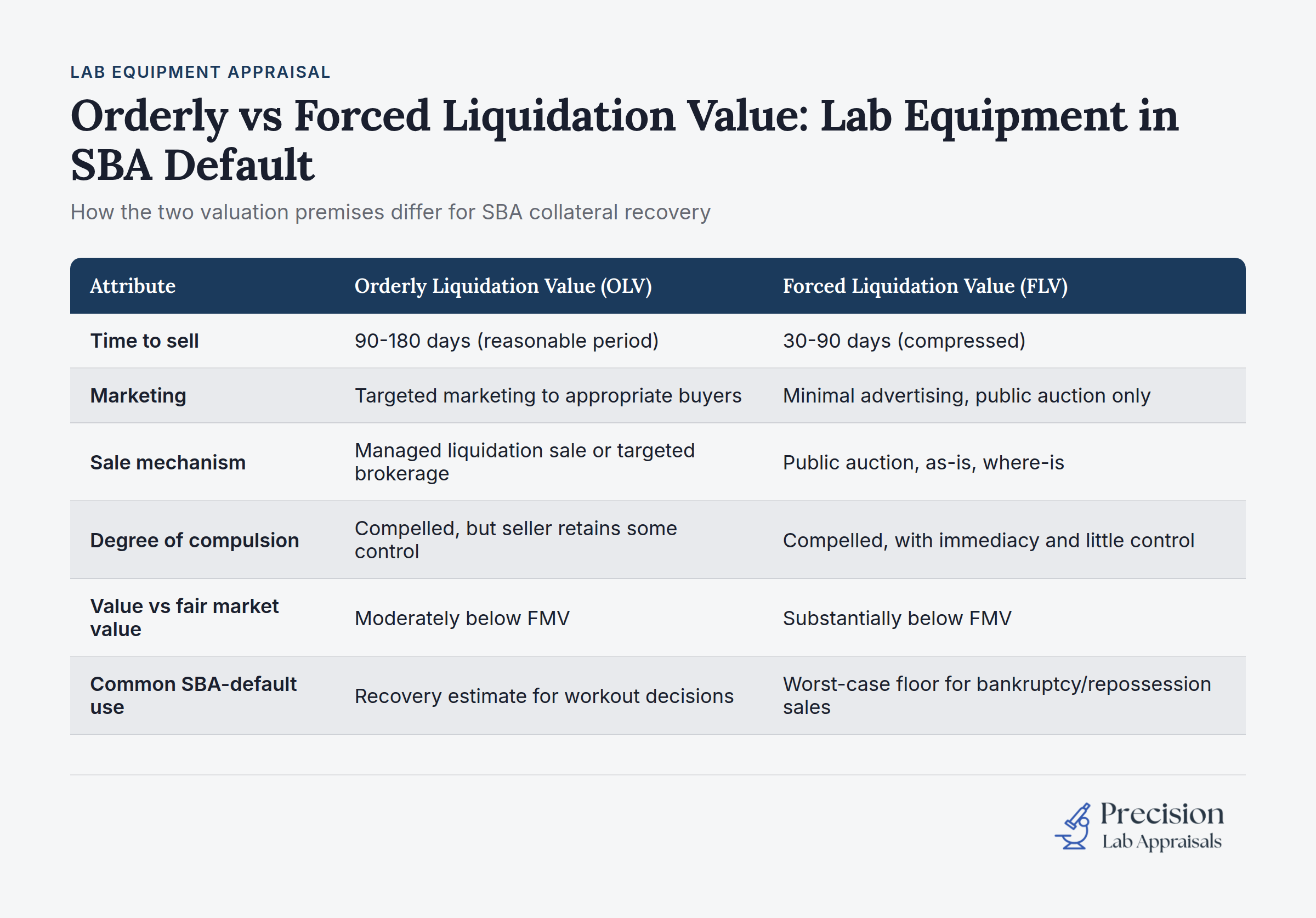
The table below summarizes how the two premises differ across the variables that matter most in an SBA collateral context.
| Attribute | Orderly Liquidation Value (OLV) | Forced Liquidation Value (FLV) |
|---|---|---|
| Time to sell | Reasonable period, commonly 90-180 days | Compressed, commonly 30-90 days |
| Marketing | Targeted marketing to appropriate buyers | Minimal advertising, public auction only |
| Sale mechanism | Managed liquidation sale or targeted brokerage | Public auction, as-is, where-is |
| Degree of compulsion | Compelled, but seller retains some control | Compelled, with immediacy and little control |
| Typical value relative to FMV | Moderately below fair market value | Substantially below fair market value |
| Common SBA-default use case | Recovery estimate for workout decisions | Worst-case floor for bankruptcy or repossession sales |
Worked Example: A Lab Equipment SBA Collateral Closure
Consider a diagnostic testing company (we'll call it Meridian Labs, a stand-in for illustration) that pledged its analytical equipment as collateral on an SBA 7(a) loan. The schedule included an HPLC system, two centrifuges, a walk-in cold storage unit, and a mass spectrometer, all in functional condition with reasonably current service records.
An appraiser engaged by the lender's workout team develops three opinions of value on the same equipment schedule, as of the same effective date:
- Fair market value: $210,000, assuming a reasonably exposed market with no compulsion to sell on either side.
- Orderly liquidation value: approximately $135,000, assuming a 120-day marketing window targeted at labs, university surplus buyers, and used-equipment brokers who specialize in analytical instruments.
- Forced liquidation value: approximately $78,000, assuming a public auction within 45 days, as-is, where-is, with no ability to pre-market to specialized buyers.
The mass spectrometer alone illustrates the spread most clearly. It's the least liquid asset on the schedule: functional, well-maintained, but with a genuinely thin market of qualified buyers. Under OLV, the appraiser can account for the handful of labs and brokers who actively watch for this equipment. Under FLV, most of those buyers never see the listing before the auction closes, and the instrument sells to whoever happens to be in the room. The common bench equipment, by contrast, holds up better under either premise because its buyer pool is deep regardless of the marketing window.
This is the exact scenario SBA lenders face when deciding how to proceed: the OLV figure supports a workout or negotiated settlement, while the FLV figure sets the floor the lender can expect if the collateral has to move immediately.
What a Forced or Orderly Liquidation Appraisal Costs
Engagements for lab equipment appraisals are quoted as a fixed fee before work begins, never billed hourly, and the fee is scoped to the assignment rather than tied to the value of the equipment itself. For standard lab equipment valuations, fees generally start at $295, with IRS-qualified or lender-required advanced reports starting at $395. Typical engagements involving a full equipment schedule and multiple premises of value (fair market, OLV, and FLV in the same report) run from roughly $695 to $2,200, and highly complex assignments involving large, specialized equipment portfolios can run from $5,000 to $10,000 or more. What drives the fee is the number of assets, the completeness of existing service and calibration records, and how many standards of value the report needs to address, not the dollar value the equipment ultimately appraises for.
Getting an SBA-Ready Liquidation Appraisal
An SBA collateral closure involving lab equipment moves fast, and the workout team needs a defensible, USPAP-compliant opinion of value under whichever premise the credit file requires, sometimes both. Our appraisers prepare orderly and forced liquidation valuations for lab equipment collateral that hold up to lender review and, when needed, court scrutiny in a bankruptcy proceeding. If you're managing an SBA default involving pledged lab instruments, our lab equipment appraisal for bankruptcy and collateral matters service is built for exactly this situation, delivering clear, standards-based reports on the timeline a workout requires.
This article is provided for general informational purposes only and does not constitute legal, tax, or financial advice. Readers should consult a qualified attorney, CPA, or SBA workout specialist regarding their specific circumstances.