
Blog
Fair Market Value vs Orderly Liquidation Value for Lab Equipment Explained
Fair market value and orderly liquidation value describe two very different numbers for the same lab instrument, and using the wrong one can undermine a donation deduction, a loan, or an insurance claim. This guide breaks down all four standards of value and maps each to the situation that requires it.
Ask what a mass spectrometer or benchtop centrifuge is "worth" and the honest answer is: it depends on why you're asking. Appraisers don't work off a single number for lab equipment; they apply different standards of value depending on the purpose of the assignment. Fair market value, orderly liquidation value, forced liquidation value, and replacement cost can each produce a materially different figure for the exact same instrument, and picking the wrong one can sink a charitable deduction, undervalue loan collateral, or leave an insurance claim short of what it takes to replace the equipment. Here's what each standard actually means, and which one applies to your situation.
Fair Market Value: The Willing Buyer, Willing Seller Standard
Fair market value (FMV) is the price a willing buyer would pay a willing seller when neither party is under any compulsion to act and both have reasonable knowledge of the relevant facts. Nobody is in a hurry, nobody is desperate, and both sides know what the equipment is and what it's worth in its market.
This is the standard the IRS requires for charitable donation appraisals. A noncash donation of lab equipment valued over $5,000 requires a qualified appraisal, and donations over $500,000 require the full appraisal report, not just a summary, to be attached to the return (see IRS.gov for current guidance). If your organization is donating surplus analyzers, incubators, or bench instruments to a university or nonprofit, FMV is the number the IRS expects to see, and it's the standard behind our lab equipment appraisal for charitable donation reports. FMV is also the right standard for an arm's-length sale of a working lab or surplus inventory, where buyers and sellers are transacting under normal market conditions rather than under any deadline.
Orderly Liquidation Value: A Compelled Sale With Time to Work It
Orderly liquidation value (OLV) assumes the seller is compelled to sell, but on a reasonable timeline and an as-is, where-is basis, rather than under panic conditions. The seller isn't choosing to sell; a bank, a lease company, or a business circumstance is forcing the decision. But there's still enough time to advertise properly and find a real buyer instead of dumping the equipment at whatever price shows up first.
OLV is typically lower than FMV because it builds in the cost and time of liquidating: de-installation, recertification, refurbishment, storage, and marketing all eat into what a buyer will ultimately pay, a pattern that holds across medical and lab equipment liquidations generally. Lenders lean on OLV heavily. A common secured-lending guideline caps advances on used machinery and equipment at roughly half of net book value, or up to 80% when the collateral has been backed by a formal orderly liquidation appraisal. For lab-specific assets like mass spec systems or chromatography units, the gap between FMV and OLV often comes down to exactly those de-installation, recertification, and refurbishment costs a secondary buyer has to absorb before the instrument is usable again.
Forced Liquidation Value: When There's No Time Left
Forced liquidation value (FLV) assumes the same compulsion to sell as OLV, but strips out the reasonable timeframe. There's a sense of immediacy: a court-ordered sale, a shutdown auction, a deadline measured in days rather than months. The equipment typically sells piecemeal, through a properly advertised auction or public sale, but the compressed window usually pushes the result below both FMV and OLV.
That said, it's a mistake to assume every auction automatically produces a forced liquidation result. A well-attended, well-advertised auction for desirable equipment can land close to fair market value; a rushed sale of niche lab instruments in a thin market can land well below it. Each sale has to be evaluated on its own circumstances rather than assumed. Bankruptcy proceedings and forced equipment auctions are the classic triggers for an FLV opinion, and our lab equipment appraisal for bankruptcy engagements are built around exactly this compressed-timeline standard.
Replacement Cost and Actual Cash Value: A Different Question Entirely
Replacement cost and actual cash value (ACV) aren't liquidation standards at all; they answer a completely different question. Replacement cost is what it would take to buy a comparable new instrument today. ACV adjusts that figure downward for the equipment's age, condition, and remaining useful life. Neither one assumes a sale is happening; both assume the owner needs to be made whole after a loss.
This is the standard behind insurance scheduling and claims. If a lab's PCR thermocycler is damaged in a flood, the policy typically settles on replacement cost or ACV, not on what the unit would have fetched at a liquidation sale. Confusing FMV with replacement cost is one of the most common reasons lab owners feel shortchanged after filing a claim. Our lab equipment appraisal for insurance coverage service establishes the correct schedule before a loss happens, so there's no ambiguity about which number applies when a claim is filed.
Four Standards of Value at a Glance
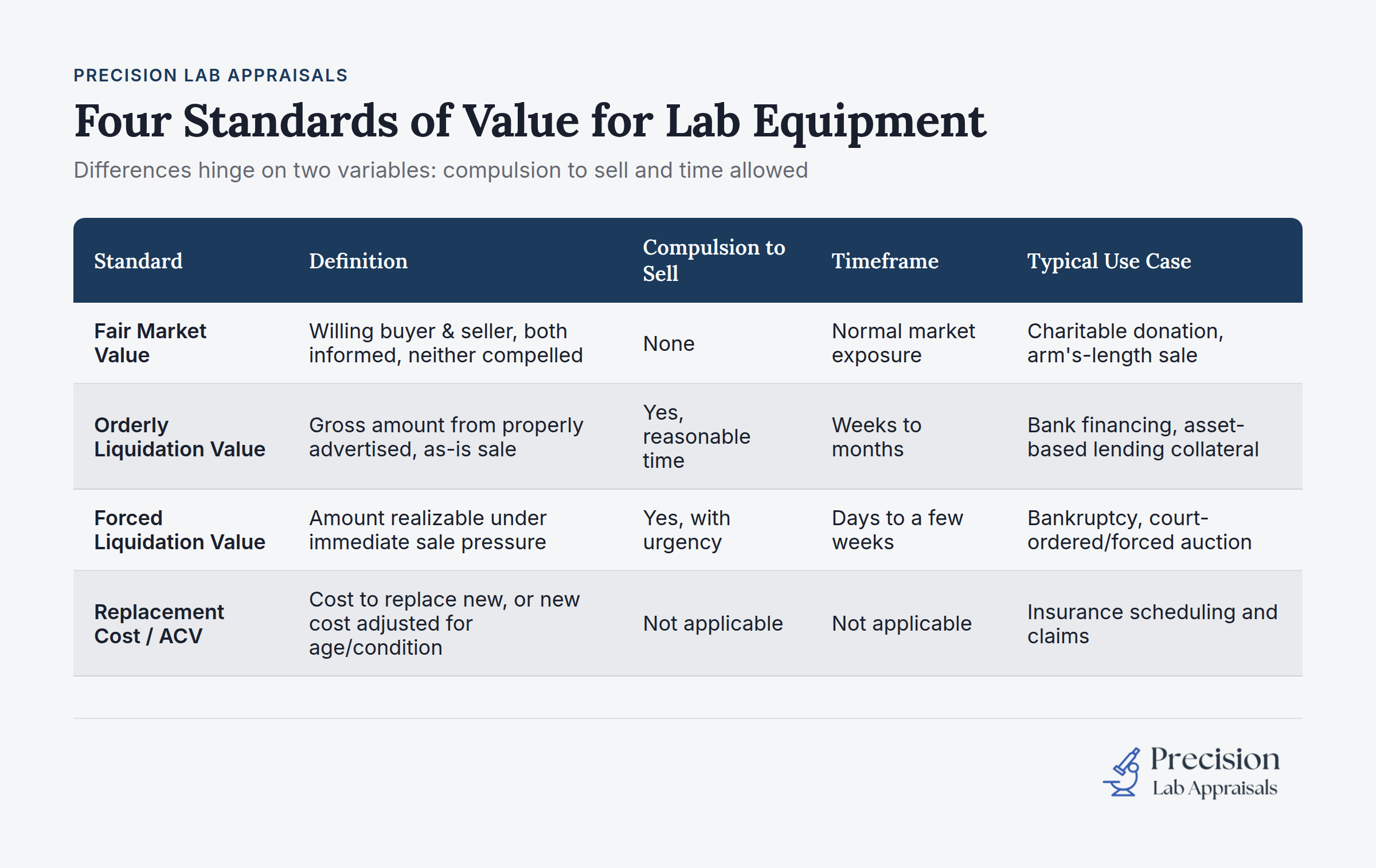
The table below lines up the four standards side by side, since the differences come down to two variables: whether the seller is under compulsion, and how much time the sale allows.
| Standard | Definition | Compulsion to Sell | Typical Timeframe | Typical Use Case |
|---|---|---|---|---|
| Fair Market Value | Price between a willing buyer and willing seller, both informed, neither compelled | None | Normal market exposure | Charitable donation, arm's-length sale of lab or surplus equipment |
| Orderly Liquidation Value | Gross amount realizable in a properly advertised, as-is sale | Yes, but with reasonable time | Roughly weeks to months | Bank financing, asset-based lending collateral, planned business wind-down |
| Forced Liquidation Value | Amount realizable under immediate sale pressure | Yes, with urgency | Days to a few weeks | Bankruptcy, court-ordered or forced equipment auction |
| Replacement Cost / ACV | Cost to replace with new, or new cost adjusted for age and condition | Not applicable, no sale assumed | Not applicable | Insurance scheduling and claims |
Which Standard of Value Applies to Your Lab Equipment?
The short version: match the standard to why the appraisal exists, not to the number you'd prefer to see. Donating equipment calls for FMV because the IRS ties the deduction directly to a willing buyer/willing seller price under IRS Publication 561's guidance. Financing or pledging equipment as collateral calls for OLV because a lender needs to know what it could recover in a controlled sale, not a best-case market price. A bankruptcy filing or forced auction calls for FLV because the timeline itself changes the achievable price. Insuring equipment calls for replacement cost or ACV because the goal is restoration, not liquidation.
The same centrifuge can carry four different, all correct, dollar figures depending on which question is being asked. Appraisers credentialed through organizations such as the ASA, ISA, and The Appraisal Foundation are trained to apply the right standard for the intended use, and every report should be prepared in accordance with USPAP regardless of which standard governs the assignment. Getting the standard wrong isn't a rounding error; it can mean a denied deduction, an undercollateralized loan, or a claim payout that doesn't cover what it actually costs to replace the equipment.
Pro tip: Before requesting a lab equipment appraisal, confirm the intended use in writing (donation, financing, litigation, insurance) so the appraiser scopes the assignment to the correct standard of value from the start, rather than producing a report that has to be redone.
This article is provided for general informational purposes only and does not constitute legal, tax, or financial advice. Readers should consult a qualified attorney or CPA regarding their specific circumstances.