
Blog
How to Depreciate Lab Equipment for Tax Purposes: MACRS, Section 179, and Basis Rules
Lab equipment depreciation for tax purposes runs through MACRS 5-year recovery, Section 179 expensing, or bonus depreciation, but every method starts with an accurate depreciable basis. This guide walks through each option and explains when a professional appraisal is the only reliable way to establish that basis.
Depreciating lab equipment sounds like a bookkeeping exercise until the basis is wrong. Get the recovery method right but the starting cost figure wrong, and every deduction that follows is wrong too. This guide covers how MACRS, Section 179, and bonus depreciation apply to laboratory and scientific equipment, and where a qualified appraisal becomes the only defensible way to establish basis.
What Counts as Depreciable Lab Equipment
Any lab asset used in a trade or business, with a useful life of more than one year, is generally depreciable once it is placed in service. That includes analytical instruments, centrifuges, autoclaves, freezers, chromatography systems, and similar fixed assets. Depreciation begins when the equipment is ready and available for its intended use, not when it was ordered or invoiced, and it continues until the cost basis is fully recovered or the asset is retired, according to IRS guidance on depreciation.
Only the business-use portion of an asset qualifies. A lab that also uses a piece of equipment for personal research outside the business must allocate the cost accordingly before applying any depreciation method.
MACRS and the 5-Year Recovery Period for Scientific Equipment
Most lab equipment placed in service after 1986 falls under the Modified Accelerated Cost Recovery System (MACRS), the default depreciation system for U.S. tax purposes. MACRS assigns fixed assets to recovery classes based on their nature and use rather than their actual expected lifespan, and IRS Publication 946 treats scientific and laboratory instruments used in research or experimentation as 5-year property.
A Treasury analysis of depreciation for scientific instruments similarly identifies qualified research equipment and technological equipment as falling under the 5-year recovery classes established in IRC §168(e)(3)(B). Under standard MACRS, the equipment's cost is recovered using a declining-balance method that switches to straight-line partway through the recovery period, spread across roughly 6 tax years once the required half-year convention is applied. The mechanism matters more than any single year's percentage: the deduction front-loads early years and tapers toward the end of the recovery period.
Watch out: Some organizations set internal capitalization thresholds, for example treating only equipment above $50,000 as a fixed asset, per one federal agency's own internal accounting policy described in IRS Chief Counsel guidance. That kind of internal threshold is an accounting convenience, not a tax rule, and it should never be mistaken for the depreciable basis or recovery period a taxpayer must use.
Section 179: Expensing Lab Equipment in the Year You Buy It
Instead of spreading the deduction over 5 years, a business can elect to expense some or all of the cost of qualifying lab equipment immediately under Section 179. For 2025, the deduction limit is $2,500,000, and it phases out dollar-for-dollar once total qualifying purchases for the year exceed $4,000,000. The election is also capped by the business's taxable income for the year, so a lab operating at a loss cannot use Section 179 to create one.
Section 179 works best for smaller or mid-sized purchases where a lab wants the full deduction now rather than spread across future years. It requires an affirmative election and supporting documentation on Form 4562, the same form used to report MACRS depreciation.
Bonus Depreciation: A 100% First-Year Deduction
Bonus depreciation lets a business deduct a percentage of an asset's cost in the year it's placed in service, on top of or instead of Section 179. Following recent legislative changes, qualified property acquired and placed in service after January 19, 2025, is eligible for a 100% special depreciation allowance, according to IRS guidance on the updated bonus depreciation rules. Unlike Section 179, bonus depreciation is not limited by taxable income and applies automatically unless the taxpayer elects out.
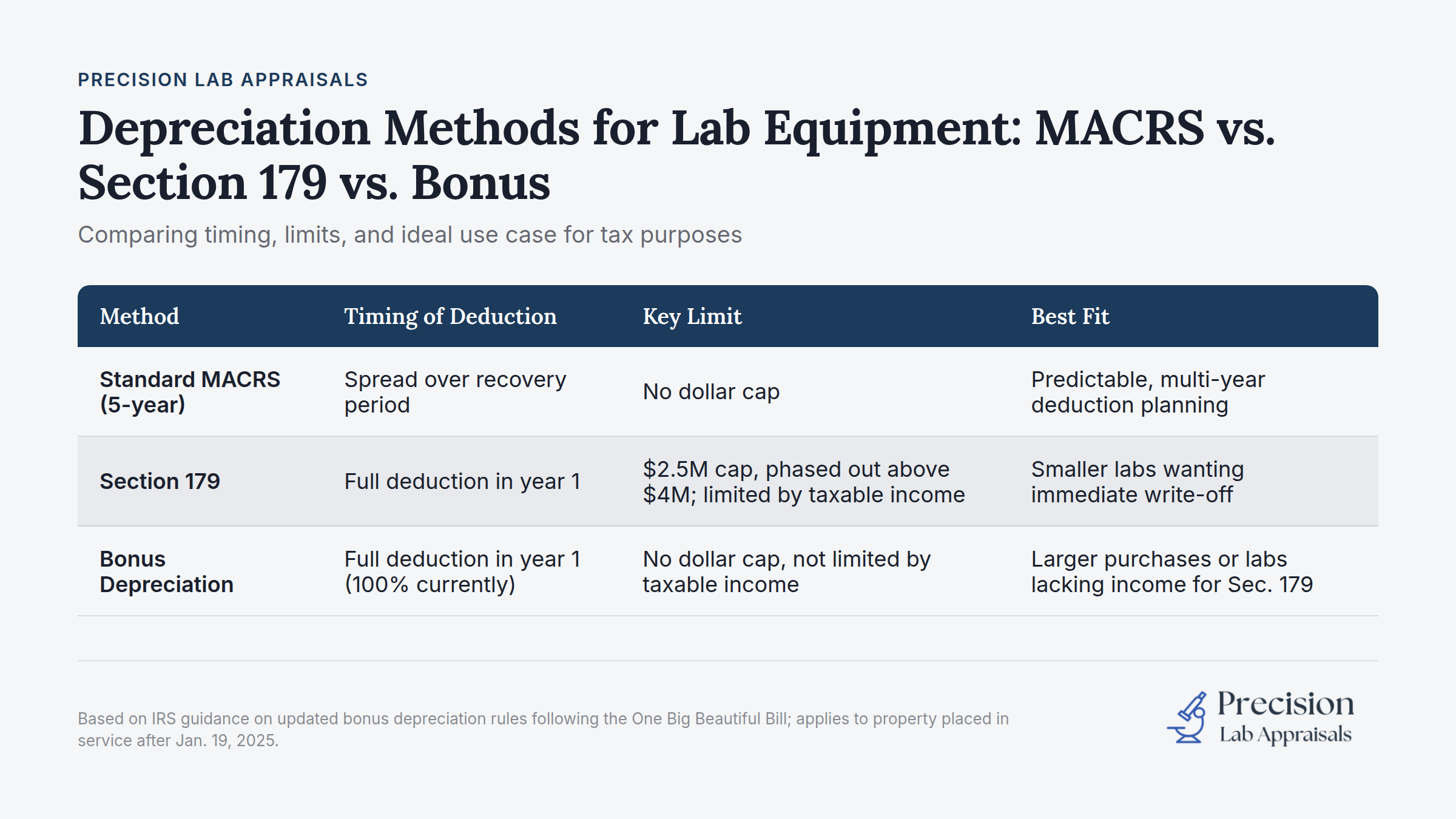
For a lab weighing all three tools, the general framework looks like this:
| Method | Timing of Deduction | Key Limit | Best Fit |
|---|---|---|---|
| Standard MACRS (5-year) | Spread over the recovery period | No dollar cap | Predictable, multi-year deduction planning |
| Section 179 | Full deduction in year 1 | $2,500,000 cap, phased out above $4,000,000 in qualifying purchases, limited by taxable income | Smaller labs wanting an immediate write-off |
| Bonus Depreciation | Full deduction in year 1 (100% currently) | No dollar cap, not limited by taxable income | Larger purchases or labs without enough income for Section 179 |
Depreciable Basis: What You're Actually Depreciating
Every depreciation method above operates on the same starting number: the asset's depreciable basis. For purchased equipment, basis is normally the original cost to the taxpayer, including freight, installation, and calibration charges necessary to put the instrument into service.
Inherited or gifted lab equipment is different. Basis for inherited property is generally its fair market value on the date of the decedent's death, not what the original owner paid, a rule covered under IRS Publication 551 for basis of assets. For a gift, basis typically carries over from the donor with some adjustments. In both cases, the taxpayer needs a defensible fair market value figure as of a specific past date, which accounting records almost never contain on their own.
When Cost Basis Is Unclear: Why an Appraisal Matters
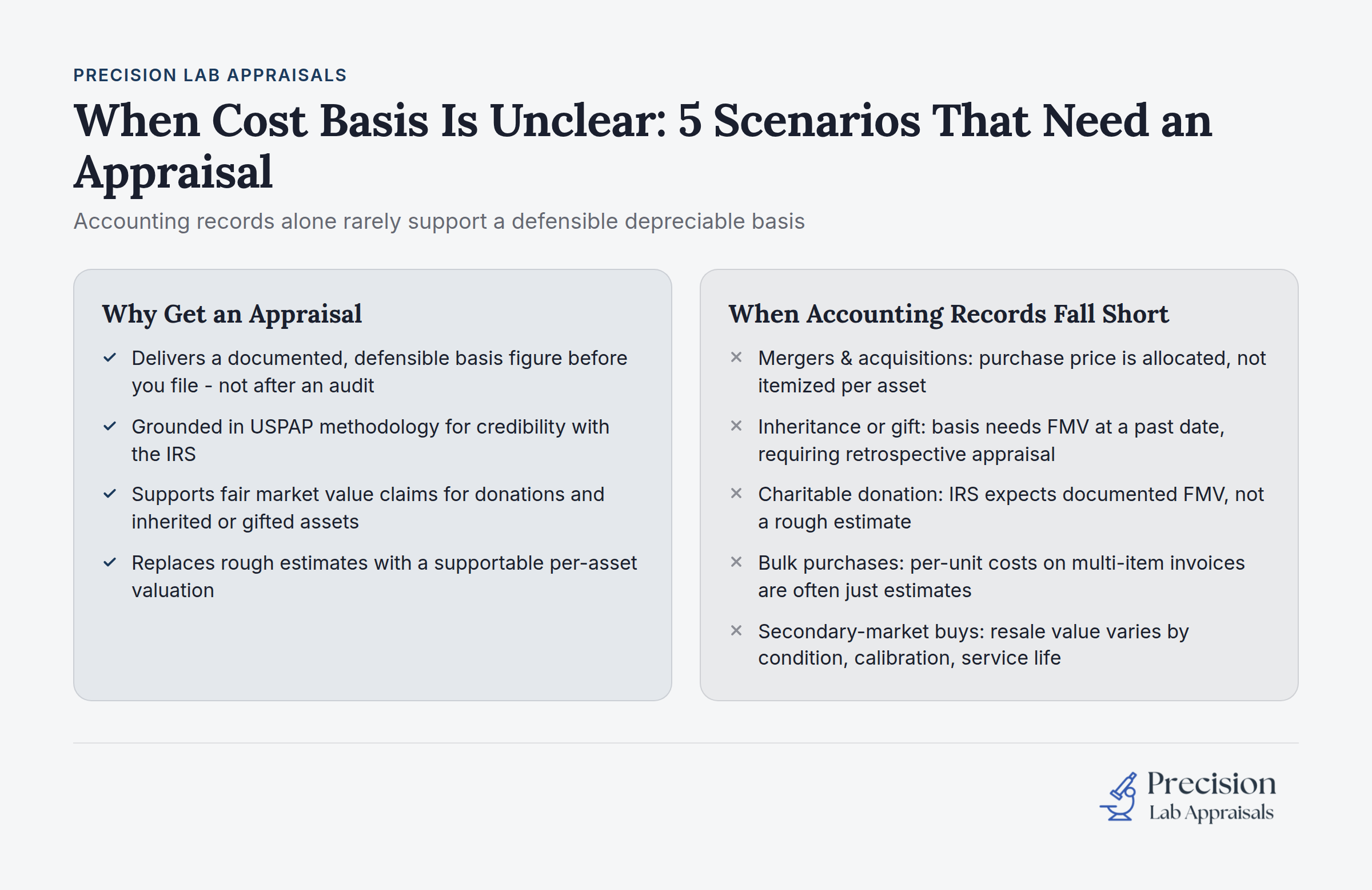
Cost basis gets murky in a handful of recurring situations, and each one calls for a professional valuation rather than a guess pulled from a ledger.
- Mergers and acquisitions: equipment acquired as part of a larger transaction often has only an allocated purchase price on the books, not a documented per-asset cost.
- Inheritance or gift: basis depends on fair market value at a specific historical date, which requires a retrospective appraisal rather than a current price quote.
- Charitable donation: a lab donating used equipment needs a defensible fair market value to support the deduction, separate from depreciation but built on the same valuation discipline.
- Bulk purchases with allocated costs: when a single invoice covers multiple instruments, the per-unit cost assigned in accounting software is frequently an estimate, not a supportable figure.
- Used equipment bought on the secondary market: resale pricing for scientific instruments varies widely by condition, calibration history, and remaining service life, so an invoice total alone rarely tells the full story.
Allocated or estimated figures pulled from accounting records should not be treated as accurate depreciable basis without appraisal support. This is standard practice in equipment appraisal work: accounting entries are built for financial reporting speed, not for defending a specific dollar figure to the IRS. A lab equipment appraisal grounded in USPAP methodology gives a lab a documented, defensible basis figure before it files a return, rather than after an examiner asks for support.
That gap shows up constantly in merger and acquisition transactions, where the purchase agreement rarely itemizes cost by individual asset, and in charitable donation scenarios, where the IRS expects a documented fair market value rather than a rough estimate.
Cost Segregation: A Related but Distinct Strategy
Cost segregation is often confused with equipment depreciation, but it solves a different problem. A cost segregation study identifies components within a larger capital project, often a building, that qualify for shorter recovery periods than the structure itself. Reclassifying assets out of a 39-year building recovery period and into a 5-year or 7-year personal property class can produce meaningful net-present-value savings, since the deduction arrives years sooner.
For a lab building out new space, cost segregation and equipment depreciation work side by side: the study addresses built-in infrastructure like specialized electrical, plumbing, and fume hood systems, while standard MACRS, Section 179, or bonus depreciation handle the freestanding instruments themselves.
Worked Example: Depreciating a $180,000 Mass Spectrometer
Example: A diagnostics lab purchases a mass spectrometer for $180,000 and places it in service in March 2025.
- Standard MACRS: the lab recovers the full $180,000 as 5-year property, with deductions front-loaded in the early years and tapering toward the end of the roughly 6-tax-year recovery window.
- Section 179: assuming the lab's total qualifying purchases for the year stay under the $4,000,000 phase-out threshold and taxable income supports it, the lab could elect to deduct the entire $180,000 in 2025 instead of spreading it out.
- Bonus depreciation: because the instrument was placed in service after January 19, 2025, it also qualifies for the 100% first-year allowance, producing the same immediate $180,000 deduction without the taxable-income limitation that applies to Section 179.
The lab's decision usually comes down to whether it wants the deduction now (Section 179 or bonus) or spread across future years for planning purposes (standard MACRS). None of these choices, however, changes the underlying requirement that the $180,000 figure be accurate. If that spectrometer had instead come through an acquisition or an estate, establishing that same $180,000 basis would require a valuation, not an invoice.
Getting the Basis Right Before You File
Choosing between MACRS, Section 179, and bonus depreciation is the easier half of this problem. The harder half, and the one that actually holds up under IRS scrutiny, is proving the dollar figure those elections are applied to. When lab equipment arrived through a purchase with a clean invoice, that's straightforward. When it arrived through an acquisition, an inheritance, a donation, or a bulk deal with allocated pricing, a documented appraisal is what turns an estimate into a supportable basis.
This article is provided for general informational purposes only and does not constitute legal, tax, or financial advice. Readers should consult a qualified attorney or CPA regarding their specific circumstances.